
Why Premium Indoor Playgrounds Are the Future of the Industry in 2026
Introduction The Evo

Table of Contents
ToggleSensory play areas integrated with outdoor playground equipment play an important role in children’s development and future trends. Sensory play promotes the development of neural connections and comprehensive abilities in children’s brains through multidimensional stimulation—including tactile, visual, auditory, olfactory, and gustatory senses, as well as vestibular, proprioceptive, and interoceptive sensations. It is suitable for children aged 0–12 and plays a particularly important role in regulating and supporting children with neurodivergence. Research indicates that regular sensory play helps improve attention, emotional regulation, and motor skills, while also alleviating screen dependency and anxiety. With the advancement of global inclusive education policies and the rise in children’s mental health issues, the sensory playground market is growing rapidly and is becoming a key infrastructure focus for schools, communities, and commercial spaces.

Evaluation Dimension | Traditional Playground | 2026 Standard Sensory Playground |
Core Design Goal | Physical exercise, casual entertainment | Targeted sensory stimulation, inclusive developmental play |
Sense Engagement | Only basic visual and gross motor engagement | Full 8-sense systematic stimulation and regulation |
User Adaptability | Designed for able-bodied kids aged 5–12 only | Age 0–12, compatible with disabled, neurodiverse, and typical children |
Space Layout | Unified mixed play zone, no functional division | Separated stimulation zones + calm retreat zones |
Equipment Function | Slides, swings, and climbing frames with a single function | Multi-functional tactile, auditory, and vestibular interactive equipment |
Safety Standard | Basic fall protection only | Sensory safety, non-toxicity, noise, and light limitation added |
In conclusion, traditional playgrounds only focus on physical exercise, while standardized sensory play areas are inclusive spaces built with professional design frameworks. They offer different types of sensory equipment to suit kids with various developmental needs, balancing stimulating activity zones and quiet calming areas to accommodate different sensory preferences, which is the core idea behind modern inclusive playground design.

In conclusion, traditional playgrounds only focus on physical exercise, while standardized sensory play areas are inclusive spaces built with professional design frameworks. They offer different types of sensory equipment to suit kids with various developmental needs, balancing stimulating activity zones and quiet calming areas to accommodate different sensory preferences, which is the core idea behind modern inclusive playground design.
For early childhood (0–6 years), the critical brain plasticity stage, sensory playgrounds act as outdoor sensory classrooms beyond kindergartens. Structured outdoor sensory input optimizes children’s central nervous system processing efficiency, helps toddlers distinguish sensory stimuli, build body awareness, and develop adaptive behaviors. Compared with indoor early childhood sensory play, outdoor sensory playgrounds provide natural light, fresh air, and large-range movement space, reducing overstimulation risks caused by closed indoor environments. Licensed early childhood therapists confirm regular outdoor sensory playground use improves children’s transition ability, classroom focus, and peer interaction willingness, laying a solid foundation for preschool adaptation and primary school learning.
Well-designed sensory playgrounds cultivate core cognitive abilities, including cause-and-effect thinking, spatial reasoning, color-shape recognition, and problem-solving skills. Interactive auditory panels, pressure-sensitive light floors, and texture-matching walls let children obtain immediate feedback through independent operation, boosting logical thinking and exploratory cognition. Zoned play settings also cultivate classification cognition; kids learn to distinguish quiet play areas and active movement areas, improving executive function and concentration. 2026 longitudinal ECE research proves that children with weekly sensory playground access score 22% higher on early literacy and spatial cognition assessments than peers without sensory play exposure.
Covering gross motor and fine motor training systematically, sensory playground equipment targets full-body physical growth. Vestibular equipment such as balance beams and adaptive swings improves balance, coordination, and core strength; tactile sensory walls, small texture knobs, and sand-water tables refine finger dexterity, wrist flexibility, and fine motor control critical for writing and daily self-care. Accessible ramps, low-height climbing structures, and wheelchair-friendly play platforms ensure children with limited mobility gain proper exercise opportunities, avoiding motor development delay caused by activity limitations. Impact-buffered ground materials also encourage bold, autonomous movement without fear of injury.
Emotional regulation is the core hidden benefit of inclusive playground design. High-stimulation zones release hyperactive emotions and excess energy for ADHD and high-energy children; shaded quiet sensory nooks with soft cushions, aromatherapy plants, and low-volume sound devices help overstimulated autistic children calm down independently. Sensory play offers controllable sensory experiences, helping children identify and express internal emotions, reduce tantrums, anxiety, and sensory fear. Unlike competitive traditional playground games, most sensory activities are non-competitive, building children’s self-confidence and sense of achievement regardless of ability level.
Shared interactive sensory facilities such as collaborative musical stations, double-sided sensory walls, and group sand tables guide spontaneous peer communication, turn-taking behavior, and cooperative play. Inclusive design eliminates ability barriers: wheelchair users and able-bodied children can operate the same interactive equipment together, fostering empathy, inclusion, and equal interaction from an early age. Guided group sensory games in playgrounds teach children boundary awareness, communication skills, and conflict resolution, building positive social cognition suitable for kindergarten and campus group scenarios.
The top principle of professional sensory playground design is balanced eight-sense integration, avoiding single-sense monotonous stimulation. Qualified 2026 playgrounds combine tactile texture diversity, adjustable visual light, controllable auditory frequency, natural plant smell, multi-directional movement, and deep-pressure proprioceptive input through carefully designed outdoor playground equipment and customized sensory play features. Designers must match sensory combinations for different scenarios: active zones adopt high-energy multi-sense combinations, while calm zones adopt low-intensity soft sensory input to support holistic sensory processing, instead of simply stacking colorful playground equipment. This integrated design guarantees effective early childhood sensory play for users of all abilities.
Age zoning is non-negotiable for safe and effective child development play. Standard zoning rules for 2026 projects: Toddler Zone (0–3): soft fully-enclosed structures, large-size tactile parts, no high-decibel sound; Preschool Zone (3–6): medium interactive sensory panels, low climbing structures, adjustable light; School-Age Zone (6–12): high-difficulty vestibular equipment, digital interactive games, team sensory facilities. Separated zoning prevents elder children’s rough movement from intimidating toddlers and matches sensory stimulus intensity to children’s developing sensory threshold.
Beyond basic fall prevention, sensory playground safety expands to sensory safety in the 2026 standards. Designers must eliminate harmful sensory triggers: flashing high-frequency lights, piercing fixed-frequency noise, sharp irritating textures, and allergenic plant materials are strictly banned. All equipment follows unified global playground safety codes, with rounded edge treatment, anti-pinch structural design, weight-bearing tested movement parts, and child-size accessible height to prevent physical injury and sensory trauma simultaneously.
A common baseline ratio for qualified sensory playgrounds is 70% active stimulation zones to 30% quiet calm retreat zones. Active zones meet exploratory play needs; semi-enclosed calm pods, foliage-shaded corners, soft deep-pressure hammock areas serve as sensory reset spaces. Children can autonomously leave busy play zones to self-regulate when feeling overwhelmed, which is a core design detail for supporting neurodiverse users. This two-area layout avoids universal overstimulation, the top design flaw of outdated sensory playgrounds built before 2025.
Modern inclusive playground design goes beyond basic wheelchair accessibility. It adopts universal design for learning (UDL) standards: multi-height operation platforms for kids of different heights and mobility levels, switch-operated sensory devices for children with limited hand strength, visual-sound dual feedback equipment for hearing-impaired and visually impaired kids, and sensory-adjustable modules that can lower light/volume on demand. The core goal is "play for all", not just physical access, enabling every child to participate independently without modification or assistance.
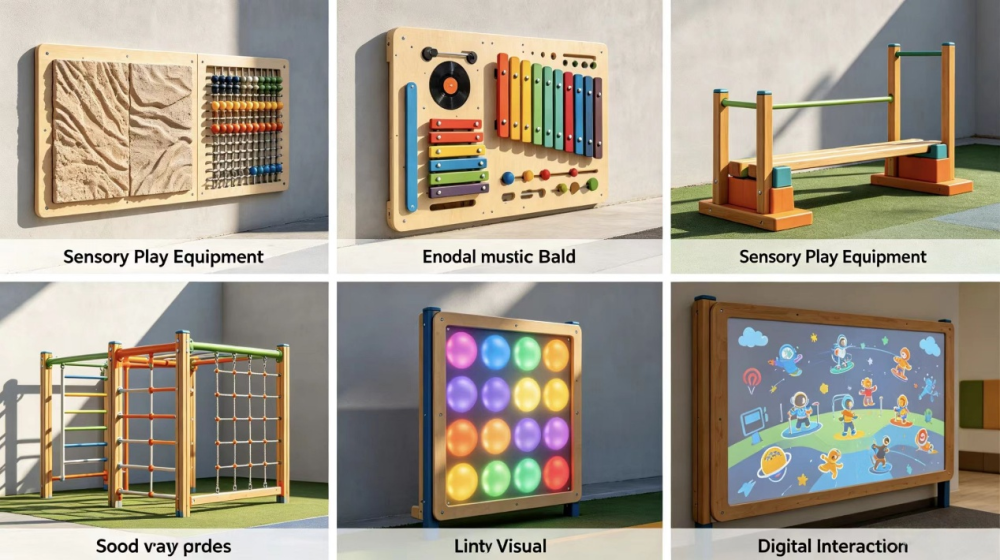
Focused on skin tactile reception and fine motor training, tactile sensory play equipment covers dry and wet texture categories. Common products: bimetal texture panels, natural bark tactile posts, silicone bump walls, pebble-embedded floors, fuzzy fabric touch boards, temperature-sensitive color-changing plates. Tactile equipment provides discriminative touch and deep touch input, helping children distinguish texture, temperature, hardness differences, and relieve tactile defensiveness for sensitive kids.
Regulated adjustable visual sensory equipment avoids unregulated strong flash stimuli per the 2026 safety rules. Main categories: gradient static LED color boards, bubble viewing tubes, rotating transparent kaleidoscope structures, natural shadow frame walls, reflective safe mirror panels, seasonal foliage viewing gardens. All visual equipment supports brightness adjustment, suitable for visually seeking children and visually avoidant neurodiverse children to choose comfortable visual input freely.
Controlled-decibel auditory sensory play equipment limits maximum playground background sound below 75dB per EN1176 standard. Classic devices: outdoor resonance chimes, drum sets, wind sound tubes, voice echo panels, ground pressure musical tiles, vibration sound boards. Auditory equipment delivers tonal, resonant, and vibration sound input, enhances auditory discrimination ability, and lets hearing-impaired kids perceive sound through structural vibration feedback.
Targeting balance, spatial rotation, and gravity perception, vestibular equipment is core for hyperactive and balance-deficit children. Certified equipment: adaptive inclusive swings, tilted spinning platforms, curved balance logs, undulating walking paths, suspended rocking bridges, zero-height rotating discs. Designed with adjustable speed and tilt angle, these structures offer mild to intense vestibular input for customized developmental play.
Delivers deep muscle compression and body weight feedback to stabilize children’s mood and body awareness. Hot 2026 equipment: weighted crawl tunnels, compression hammocks, push-pull resistance walls, heavy block stacking sets, shoulder squeeze frames, bouldering strength walls. Proprioceptive input is the most effective calming sensory input, widely used in therapy-oriented sensory playgrounds for emotional regulation intervention.
New-generation low-sensory-load interactive digital equipment updated for 2026, different from high-stim arcade devices. Products: weather-adaptive projection play floors, Bluetooth adjustable sensory control panels, touchless interactive light walls, app-linked modular sound devices. All digital equipment supports manual sensory parameter locking by caregivers, preventing sudden light/sound changes that trigger sensory panic.
Cost-effective modular sensory walls rank as the most popular retrofit equipment for schools and community spaces. Customizable panel combinations include gear rotating panels, maze bead panels, water flow bubble panels, braille texture panels, and magnetic puzzle boards. 2026 upgraded modular walls support height adjustment, wheelchair side operation, and detachable texture replacement, meeting seasonal play renewal needs while fitting inclusive playground design standards. Wall-mounted design saves ground space, ideal for small indoor and outdoor sensory play areas.
Nature-matched low-flicker LED systems and interactive ground projection games are mainstream commercial playground picks. Recommended designs: warm-toned dynamic tree shadow projection, step-triggered soft-color floor lights, weatherproof interactive cloud projection walls. All lights adopt a flicker-free DC power design, eliminating epilepsy-triggering stroboscopic effects. Projection content can switch between active game mode and static starry sky calm mode for dual-scene use.
Weatherproof integrated outdoor musical play stations feature height-layered instrument sets for multi-age use. Configurations include bass resonance drums, pentatonic wind chimes, metal vibration bars, and collaborative pipe sound sets. Dual playing modes: solo independent play and group cooperative ensemble play. Installed sound insulation baffles reduce cross-zone noise interference, ensuring musical zones will not disturb adjacent quiet, calm areas.
Multi-texture inclusive climbing and movement structures combine vestibular and proprioceptive input. 2026 optimized ideas: natural wood-textured climbing walls, net wrap gentle rocking climbers, wheelchair-accessible ramp climbing systems, undulating balance stepping stones. Structures reserve handhold positions for disabled children, adopt non-slip all-weather surface treatment, and divide low, medium, high difficulty routes for differentiated developmental play.
Adjustable-height water and sand sensory tables are essential early childhood sensory play facilities. Outdoor models adopt anti-rust food-grade material, are equipped with water circulation systems, filtered sand pools, and detachable partition boards. Kids can conduct pouring, digging, floating, and shape-building activities to boost hand-eye coordination. Seasonal upgrade design allows switching sand to snow, beans, or colored particles for year-round diverse tactile experiences, suitable for early learning centers and FEC indoor zones.
Nature-inspired multi-texture play zones integrate artificial and natural sensory materials. Layout ideas: mixed ground zone with grass, rubber, pebble, wood chip flooring; tactile plant garden with non-toxic fuzzy leaves, smooth bark, fragrant herb plants; soft ground cushion zone with varied fabric texture mats. This zone provides unstructured free tactile exploration, aligning with 2026 nature-inspired sensory playground design trends, and lowers sensory adaptation pressure for sensitive beginners.

Scientific zoning follows the "from calm to active" sequential layout principle. Standard partition modules: entrance sensory buffer zone → toddler low-stimulation zone → school-age active multi-sense zone → inclusive interactive zone → independent calm retreat zone → caregiver rest observation zone. Physical separation methods include low plant hedges, wooden partition walls, rubber ground color division, and avoiding hard closed fences. Zoning must reserve flexible transition spaces for children to adjust play rhythm freely.
Circulation paths adopt a minimum 1.2m-wide barrier-free main walkways compatible with wheelchairs and strollers. One-way circulating play routes avoid crowd collision and cross-sensory interference: high-noise auditory zones set at the playground edge, far away from quiet rest and toddler zones. Branch paths connect independent functional zones without crossing, ensuring children can switch play areas without passing high-stimulation zones randomly, optimizing overall sensory experience flow.
2026 layout mandatory specifications: natural daylight priority design, add dimmable auxiliary night lighting without blue light; partition sound absorption materials installed between functional zones to control zone noise diffusion. Designers set fixed sound limit zones, install adjustable light controllers, and reserve manual emergency sensory adjustment switches for caregivers to cut off strong light or loud sound instantly during sensory emergency events.
All sensory play zones maintain 100% caregiver visible sightlines, with no blind hidden corners. Calm pods adopt a semi-open woven structure instead of fully enclosed rooms for easy real-time supervision. Elevated play equipment installs transparent guardrails, and monitoring viewpoints are set at the playground's core corners. Visibility design balances children’s independent play, privacy and safety supervision, meeting school and public venue management requirements.
All commercial and public sensory playgrounds must comply with dual international standards in 2026: ASTM F1487 (US public playground safety standard) and EN1176 (EU inclusive sensory playground equipment standard). Updated clauses cover sensory-specific rules: limited flash frequency below 3Hz, playground ambient noise capped at 75dB, inclusive equipment load-bearing standard for disabled users, modular structure anti-loose certification. Custom-exported playground equipment needs third-party dual-standard certification before installation and operation.
Full-site material environmental standard: E0 grade solid wood, food-grade silicone, lead-free coating, recycled low-odor rubber, non-allergenic natural plants. Ban formaldehyde-containing composite boards, dyed toxic sand, volatile artificial fragrance materials, and sharp recycled plastic parts. All contact materials pass skin-sensitivity testing, adapting to children with sensitive skin and low immunity in early childhood sensory play scenarios.
Zoned ground cushion configuration per fall height: 50mm rubber granules for flat play zones, 100mm EPDM impact-absorbing surface under climbing and swing equipment, natural wood chip buffer ground for nature sensory zones. Edge ground slope designed at less than 1:12 for wheelchair rolling safety. Ground color adopts a low-saturation matte color to avoid visual reflection stimulation for visually sensitive children.
High-speed rotation, high-height climbing, and high-volume musical areas are defined as marked risk zones. Risk zones set isolation buffer distance ≥2m from casual play zones, post clear age and ability warning signs, and install speed-limiting structural parts. Risk zones provide optional auxiliary safety belts and handrails, turning uncontrollable play risks into manageable graded risks, which helps children build risk-assessment ability within safe boundaries.
Formulate tiered inspection rules: daily on-site check of sound-light electronic equipment, weekly fastening of movable sensory parts, quarterly material safety testing, annual third-party ASTM/EN standard recertification. Digital sensory equipment needs regular system upgrades to avoid sudden program failure. Reserve universal replacement parts for modular sensory panels to lower long-term operation and maintenance costs for venue operators.
As standard outdoor classroom facilities, kindergarten and primary school sensory playgrounds align with inclusive education courses. Design focuses on age zoning, teaching-linked sensory equipment, and easy daily management. Teachers can integrate sensory playground activities into daily occupational therapy, outdoor art, music courses, assisting special education teachers in conducting group sensory intervention for neurodiverse students.
Commercial indoor sensory FECs adopt climate-adaptive digital sensory equipment, compact modular sensory walls, and central controlled light-sound systems. Operators design ticketed sensory theme sessions, set low-sensory business hours for autistic family visits, and differentiate play packages to expand customer groups beyond ordinary family guests, improving venue utilization rate on weekdays.
Medical-grade therapy sensory playgrounds customize adjustable sensory modules under occupational therapist guidance. All equipment supports parameter adjustment: sound volume, light brightness, movement resistance, and texture hardness. Mainly used for SPD intervention, autism sensory rehabilitation, pediatric motor function recovery, equipped with professional observation recording systems to track children’s developmental progress for clinical treatment data support.
Mall public sensory play spaces adopt a small-footprint, high-interaction design, and set independent quiet corners to accommodate shopping families' rest needs. Inclusive design ensures disabled child families can consume and rest comfortably on-site, improving the mall's kindness rating. Branded sensory playground zones also become mall social check-in spots, boosting pedestrian flow and surrounding retail consumption.
Government-funded community sensory playgrounds focus on low maintenance cost, nature integration, and full-age adaptability. Built with eco-friendly local materials, they serve permanent residents of all ages, provide free public sensory play resources, reduce family commercial play consumption pressure, and build inclusive, friendly community environments compliant with 2026 urban child-friendly city assessment standards.
The most prevalent design error: excessive stacked colorful lights, overlapping background music, dense high-texture equipment without buffer areas. Long-time stay in overstimulated spaces causes meltdown, headache, anxiety, and sensory fatigue for neurotypical and neurodiverse children alike. 2026 design code requires pre-opening sensory load testing to verify overall stimulus intensity qualifies for long-term child play.
Typical flawed layouts: mixing quiet and active zones, placing toddler areas beside loud musical zones, lacking independent calm spaces. Mixed zoning leads to sensory cross-interference, unable to meet the dual needs of play excitement and emotional reset. Many small-budget projects cancel dedicated calm zones to save space, which greatly reduces playground inclusivity and developmental value.
Common safety shortcuts: adopting non-certified cheap flashlight equipment, using untested recycled texture materials, simplifying impact-absorbing ground layers, ignoring sensory trigger risk assessment. These projects pass only basic physical safety inspection but fail sensory safety audit, facing rectification risk and child injury liability for public operation venues.
Many outdated playgrounds only equip visual and tactile facilities, lacking vestibular and proprioceptive devices critical for emotional regulation. Single-sense equipment can only realize entertainment functions and cannot support systematic child development play. Balanced six-category sensory equipment matching is required to achieve comprehensive developmental benefits per modern sensory playground design standards.
Unreasonable circulation, blocked sightlines, poor light-sound isolation, and unreasonable sun exposure layout belong to layout defects. Poor planning increases caregiver supervision difficulty, raises zone mutual interference, and shortens whole-site service life. Professional layout must combine site orientation, wind direction, pedestrian flow, and sensory transmission rules instead of random equipment placement.
Wireless unified smart playground control systems become standard: managers adjust full-site light, sound, equipment operation mode via tablet terminal, preset low-sensory, party active, and toddler gentle three scene modes. System auto detects ambient noise and light intensity to auto-adjust parameters, realizing intelligent sensory environment management for public playgrounds.
Cutting-edge 2026 AI adaptive sensory technology: built-in behavior recognition sensors capture children’s play emotions and movement state. AI automatically upgrades or reduces equipment stimulus intensity, recommends matched sensory activities, and generates weekly play developmental reports for parents and teachers. Mainly applied in high-end schools, rehabilitation centers, and premium FEC sensory playground projects.
Eco low-flicker solar LED integration replaces traditional wired decorative lights. Interactive LED modules link with ground pressure sensors, realizing step-triggered color and sound linkage. All digital parts adopt rainproof, dustproof grade IP65, suitable for long-term outdoor use, balancing interactive play fun and energy-saving environmental protection design requirements.
Abandoning exaggerated cartoon artificial modeling, 2026 mainstream design adopts forest, stream, bionic plant themed sensory spaces. Maximize native fragrant plants, natural stone, log, and running water elements to deliver original low-pressure sensory input. Nature-based sensory playgrounds lower children’s psychological alertness and better relieve screen-induced sensory tension than fully artificial playgrounds.
Inclusive design upgrades from basic accessibility to personalized sensory accessibility: add visual-aid braille play parts, vibration auditory feedback devices, adjustable-support swing sets, and wheelchair lockable play platforms. Design teams cooperate with occupational therapists and disabled children consultants in the early design stage, realizing truly barrier-free play for neurodiverse, physically disabled, and sensory-impaired groups.
Global sensory playground market will hit 4.12 billion USD scale in 2026, with North America and European markets saturated, Asia-Pacific emerging markets growing at a 15.3% annual rate. Policy-mandated inclusive facility upgrading, parent consumption upgrading, and special education facility expansion jointly sustain long-term market demand, bringing stable order volume for playground design and equipment suppliers.
Multi-dimensional profit models for commercial sensory playgrounds: regular admission tickets, special sensory therapy courses, equipment customized sales, playground turnkey design construction projects, after-sale modular replacement maintenance services. Public venues gain government-inclusive project subsidies; private venues achieve premium pricing compared with ordinary traditional playgrounds due to inclusive sensory attributes.
Themed sensory birthday parties, inclusive community carnival, and pediatric popular science sensory events become high-margin secondary profit projects. Adjustable playground scene modes support private party customization, low-sensory inclusive party services for disabled children’s birthday gatherings, filling a local niche event market blank and improving off-peak revenue.
Modular detachable sensory equipment supports monthly theme updating, maintaining a fresh play experience for regular child visitors. Data from 2025 FEC operation cases shows sensory playground customer revisit rate is 37% higher than that of traditional playgrounds. Stable repeat customer flow guarantees long-term stable operating income for venue operators.
First-stage targeted user assessment: confirm user age range, proportion of neurodiverse/abled/disabled children, user sensory sensitivity characteristics, venue use purpose (education, therapy, commercial, community). Collect demands from teachers, therapists, parents, and management staff to define the stimulus intensity, inclusive level, and budget range of the playground.
Conduct a site survey covering area size, orientation, noise surroundings, sunlight condition, ground bearing capacity, and passage width. Draw a functional zoning sketch, divide active/calm zones, plan barrier-free circulation routes, confirm equipment placement reserved space, and complete a preliminary compliance assessment with ASTM/EN safety codes.
Output themed design renderings, sensory stimulus scheme, material sample list, light-sound control scheme. Optimize balance of stimulation and calm layout, submit inclusive design proof document, adjust design scheme according to stakeholder feedback, and finalize confirmed construction blueprint before equipment procurement.
Select dual-standard-certified sensory play equipment matching age zoning and sensory scheme; prioritize modular detachable structures for later renewal. Match tactile/visual/auditory/vestibular/proprioceptive/digital equipment proportion reasonably, reserve auxiliary safety accessories and replacement parts, verify the material non-toxic certification report before purchasing.
A professional certified construction team completes ground buffer laying, barrier-free passage transformation, electronic sensory equipment wiring, and zone partition installation. Finish full-site sensory safety testing, load-bearing inspection, noise-light detection, obtain ASTM/EN acceptance report, provide operator training for daily equipment adjustment and routine maintenance before official opening.
Sensory playground design is a professional, inclusive spatial design discipline that combines child development psychology, occupational therapy, playground safety engineering, and universal design theories. It builds purpose-built outdoor and indoor play spaces with matched multi-sense equipment, zoning layout, and sensory control systems to provide regulated, safe, developmental sensory play experiences for children of all abilities, covering neurodiverse and disabled groups.
Sensory play optimizes children’s neural sensory processing ability and boosts cognitive, physical, emotional and social four-dimensional development. It helps typical children improve focus and motor ability, assists neurodiverse children with sensory self-regulation, reduces anxiety and sensory meltdowns, cultivates inclusive awareness, and lays a physiological and psychological foundation for campus study and social interaction.
Qualified sensory playground equipment falls into six core categories: tactile texture panels, adjustable visual light devices, controlled-decibel auditory musical facilities, vestibular balance movement structures, proprioceptive compression strength equipment, and low-stim interactive digital devices. All equipment needs international playground safety certification and sensory trigger risk assessment.
Standardized sensory playgrounds complying with ASTM F1487 and EN1176 are safer than traditional playgrounds, for they add sensory safety protection besides physical fall protection. Custom light-sound limit, non-toxic materials, impact ground, risk zoning design prevent physical injury and sensory trauma. Uncertified self-assembled sensory facilities without professional design have hidden safety risks.
2026 cost reference: community basic sensory zone: 80–150 USD per square meter; school standard inclusive sensory playground: 160–280 USD per square meter; commercial smart digital sensory playground: 300–450 USD per square meter; medical rehabilitation customized therapy playground: quotation based on personalized adjustable module demands. Cost varies by material grade, smart configuration, and inclusive upgrade degree.
Sensory playgrounds are inclusive public spaces supporting child development, reducing gaps, improving sensory regulation and emotional balance, and delivering educational, social and commercial value for families, schools, and communities.
Design principles include multi-sensory integration, age zoning, safety compliance (ASTM/EN1176), balanced stimulation and calm areas, and universal inclusivity, prioritizing experience over aesthetics and avoiding overstimulation.
Future development integrates AI adaptive technology, eco-friendly materials, and personalized modules linked to education and health. As demand for inclusive and sensory-rich environments continues to grow, custom outdoor playground equipment will play a key role in creating engaging, development-focused play spaces for children of all abilities. KanbeiPlay specializes in Custom Playground Solutions, offering innovative outdoor playground equipment tailored to site conditions, age groups, educational goals, and sensory development needs. From concept design and manufacturing to installation and compliance support, KanbeiPlay provides customized, standards-compliant solutions that help schools, parks, communities, and commercial projects build safe, inclusive, and future-ready playgrounds.
Introduction The Evo
Introduction When de
Thank you very much for your inquiry! Your trust is our greatest motivation. We are committed to offering playgrounds that combine high quality with affordable pricing. Let us bring vitality to your venue!