
Quick Answer
Before ordering from an indoor playground manufacturer, verify who will contract with you, where the equipment will be produced, and which company controls design, quality checks and after-sales support. Request project-specific drawings, material specifications, relevant test documents, an itemized quotation and a written installation scope. Compare each supplier against the same venue brief. Factory photos and certification logos are starting points, not a complete purchasing decision. Move forward when the evidence matches your proposed equipment and the quotation clearly allocates shipping, site preparation, installation and handover responsibilities. Confirm destination-market requirements with the relevant local professionals before approving the final design.
What Should a Manufacturer Evaluation Include?
| Check | Evidence to request | Decision before ordering |
|---|---|---|
| Company identity | Business registration, contracting entity and factory address | Who is responsible for the order? |
| Production capability | Current production footage and a process walkthrough | Who makes and checks each major component? |
| Design capability | Venue-specific layout, dimensions and equipment list | Does the proposal fit the actual building? |
| Documentation | Applicable reports with identifiable equipment and scope | What is covered and what remains to be confirmed? |
| Quotation | Specifications, inclusions, exclusions and delivery terms | Are competing prices based on the same scope? |
| Installation | Site-readiness checklist and responsibility schedule | Who supplies labor, tools and local works? |
| Support | Warranty terms, maintenance information and parts references | How will the operator obtain help after handover? |
1. How Do You Verify the Company Behind the Quotation?
Ask for the supplier’s registered company name, business registration details, factory location and contracting entity. Check that the quotation, purchase agreement and payment instructions identify the expected parties. Ask for an explanation when a brand name differs from the legal company name.
A factory, trading company or local distributor can have a role in a project. The useful question is who controls production, approves changes and takes responsibility for defects. Record those responsibilities instead of treating a business label as proof of quality.
2. What Factory and Production Evidence Should You Review?
Request recent factory footage showing the processes relevant to your order. A walkthrough should connect incoming materials, fabrication, component preparation, assembly checks and packing. Ask which items are produced internally, which are sourced, and how purchased components are inspected.
Request a sample inspection record or an agreed inspection plan. Compare it with your equipment list and drawings. If a factory visit or independent inspection is part of your purchasing process, agree on access, inspection scope and corrective actions before placing the order.
3. Can the Manufacturer Design for Your Actual Venue?
Give suppliers the same floor plan, usable area, clear ceiling height, column positions, entrances, exits and target age groups. Ask how the layout addresses circulation, supervision, maintenance access and the selected attractions. A colorful rendering alone does not establish that the equipment fits the building. The indoor playground equipment category can help you review the equipment types available before finalizing a venue brief.
KanbeiPlay is an indoor playground manufacturer whose equipment range includes indoor playgrounds, trampoline parks, soft play, ninja courses and adventure play. Its project services cover custom design, manufacturing, installation support and after-sales assistance. For a proposed order, ask the team to identify the included equipment, design deliverables and support responsibilities in writing.
Compare the equipment list with the layout and quotation. Resolve changes in dimensions, age zoning and attraction selection before approving production. Keep the approved drawing revision identifiable.
4. How Should You Check Safety Documents and Their Scope?
Request documents relevant to the proposed equipment and destination market. Review the named manufacturer, product identification, referenced requirements, issuing organization, dates and stated scope. Ask how the document relates to your ordered configuration, especially when the design or materials change.
Management-system certification and product test documentation answer different questions. A logo or certificate image does not establish that every attraction or installation is covered. Confirm questionable documents with the issuing organization.
Keep equipment documentation separate from building, fire, accessibility, insurance and operating approvals. Identify which checks require local professional or authority review. Do not interpret a supplier’s equipment report as permission to open the venue.
5. What Must an Itemized Quotation Include?
Compare quotations against a common equipment list and drawing revision. Check materials, component specifications, padding, netting, flooring, gates and any interactive systems included in the proposal. Ask suppliers to explain substitutions.
Separate the equipment price from packing, international freight, destination charges, duties, unloading, storage, installation and local site works. Record the currency, delivery terms, quote validity, payment milestones and change-order process. A lower headline price is difficult to assess until these boundaries match.
6. Who Handles Shipping, Installation and Handover?
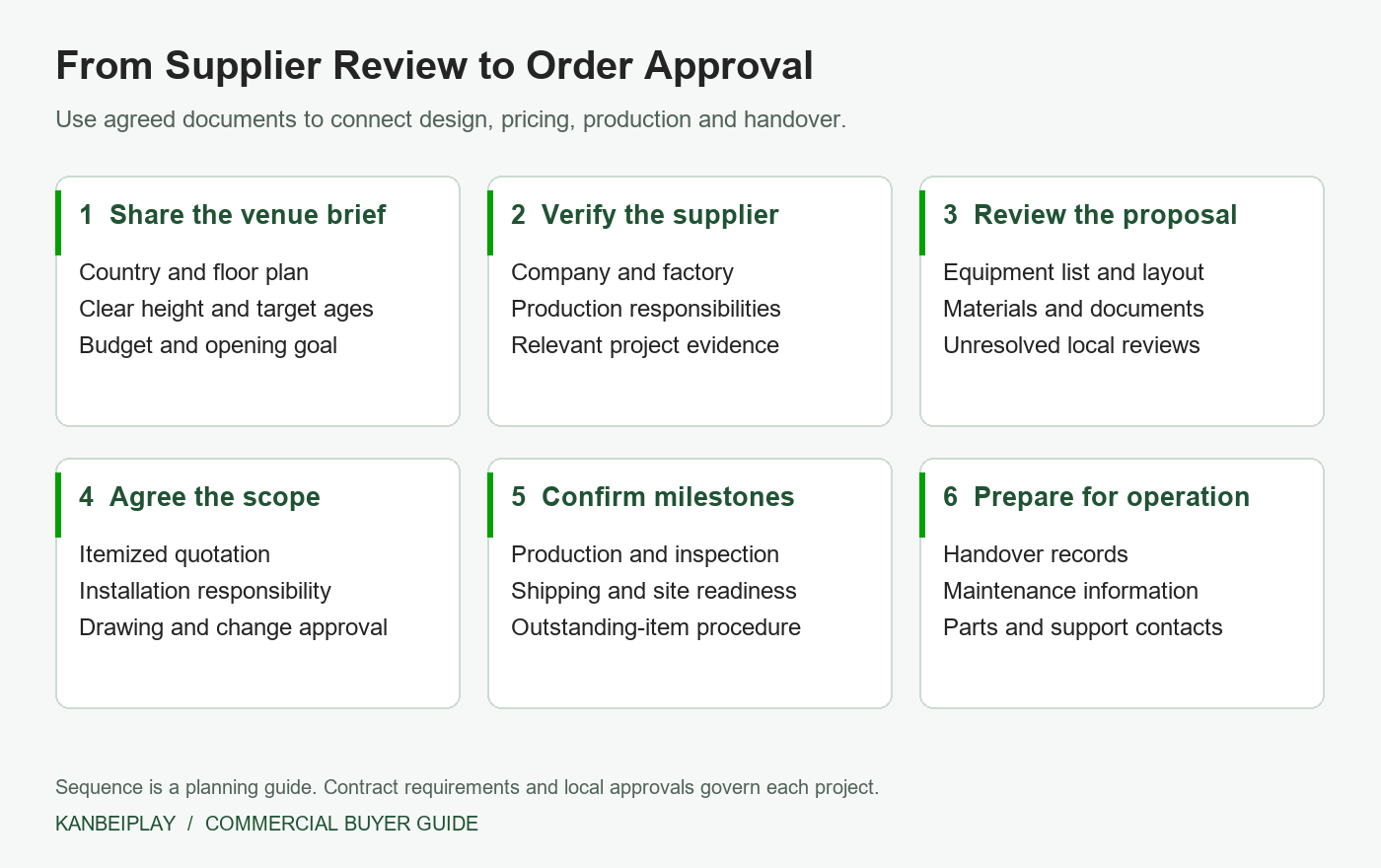
Clarify whether the offer includes installation drawings, remote guidance, a traveling supervisor or an installation team. Confirm who provides local labor, tools, lifting equipment, travel arrangements and site access. Request a site-readiness checklist before shipment. Review the installation support information, then confirm the scope included in your own quotation.
Build the schedule around drawing approval, production, inspection, shipping and site readiness. Agree on handover records, outstanding-item handling and the checks needed before operation. Delivery dates should reflect the actual order and logistics plan rather than a general website estimate.
7. How Will Warranty and Spare Parts Work After Opening?
Read the written warranty for covered components, exclusions, claim procedures and responsibility for labor or freight. Ask how normal wear, misuse and maintenance affect coverage. Request the maintenance instructions relevant to the installed equipment.
Check how replacement parts are identified. An agreed parts list, drawing reference or component code can help the operator explain a problem. Confirm the support contact and information needed for a claim; do not assume every component is held locally or can be replaced immediately.
What Information Should Buyers Prepare?
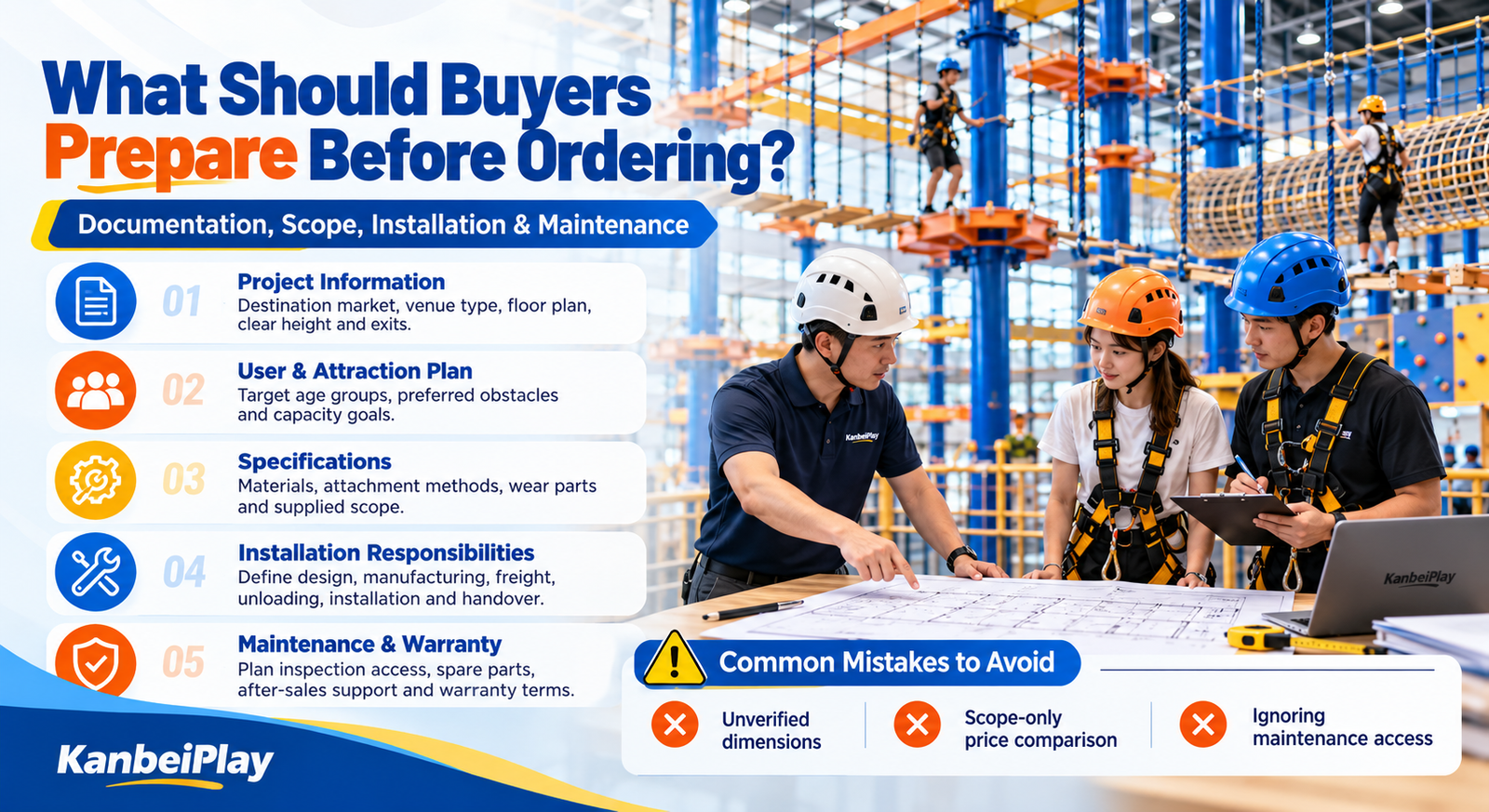
Prepare your country and city, venue type, floor plan, usable area, clear height, columns, entrances and exits. Add target ages, preferred attractions, theme, budget range and intended opening date. State whether you need equipment supply, installation supervision or a wider project scope. Share known landlord and local-review requirements so suppliers can identify unresolved inputs before quoting.
Common Mistakes to Avoid
- Accepting factory images without connecting them to the contracting supplier.
- Comparing prices that include different equipment or installation scopes.
- Treating certification logos as evidence for the entire proposed venue.
- Approving a rendering without checking dimensions and drawing revisions.
- Leaving warranty, site preparation and spare-parts arrangements until shipment.
Frequently Asked Questions
Is buying directly from a factory always the better choice?
No. Compare production control, communication, local service and contractual responsibility. Direct access to manufacturing is useful when the supplier can support the required project scope.
What should I request before paying a deposit?
Request verified supplier details, an agreed equipment scope, identifiable drawings, a detailed quotation and written commercial terms. Resolve responsibility gaps before payment.
Does a certificate cover all indoor playground equipment?
Do not assume so. Check the document’s product identification, referenced requirements and scope against the equipment being ordered.
Can I use a supplier’s standard layout for my venue?
Use it as a starting point. The final proposal must account for actual dimensions, building constraints, target users and applicable local requirements.
What should I do if two quotations are difficult to compare?
Send both suppliers the same scope checklist. Request revised quotations identifying inclusions, exclusions, specifications and installation responsibilities.
Commercial Buyer Checklist
- Contracting entity and factory details checked.
- Relevant production processes and inspection plan reviewed.
- Layout checked against the actual venue.
- Equipment list and approved drawings aligned.
- Document scope matched to the proposed equipment.
- Equipment, freight and local costs separated.
- Installation and handover responsibilities recorded.
- Warranty, maintenance and spare-parts process clarified.
Final Thoughts
Evaluate a manufacturer through a connected chain of evidence: company identity, production capability, venue-specific design, applicable documentation and written delivery responsibilities. Address unresolved questions before approving the order. Clear scope makes supplier comparisons more useful and gives both parties a shared basis for delivery.
To discuss a KanbeiPlay project, send your floor plan for a project review, including your country, usable area, clear height, target ages, budget range and intended opening date. Ask for an itemized proposal that identifies the equipment, installation support and buyer responsibilities.