How to Select a Suitable Venue for an Indoor Playground Project?
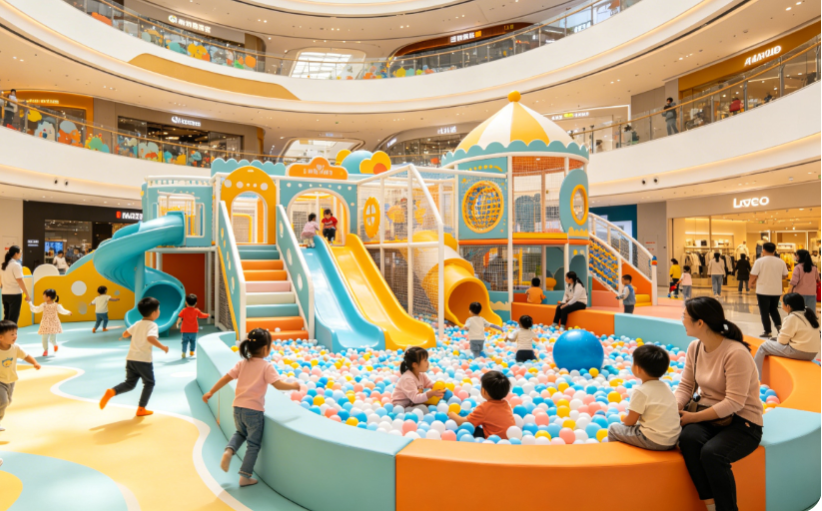
Table of Contents
ToggleIntroduction
How to Select a Suitable Venue for an Indoor Playground Project? It decides its future business performance. A proper location can attract more families and ensure stable daily operation.
Why Venue Selection Is Critical for Indoor Playground Success
Indoor playground venue selection is the core of the success of an indoor playground. A well-chosen playground business location helps avoid operational risks and secure steady revenue.
Relationship Between Location, Traffic, and Profitability
Location and traffic directly determine earnings. A quality indoor playground location delivers stable customer flow and better revenue.
Location, foot traffic, and profitability are closely interrelated. Site location and traffic directly impact earnings; in turn, a premium mall indoor playground location attracts more visitors and boosts overall profits.
Overview of Indoor Playground Site Selection Process
FEC site selection follows a standardized process consisting of market research, site inspection and cost calculation, which aims to screen legally compliant commercial indoor playground space for investment.
Key Factors for Selecting an Indoor Playground Venue
Foot Traffic and Customer Density
The quality of passenger flow is the first criterion for indoor playground venue selection. Give priority to sites with dense family customers, and focus on checking the effective parent-child passenger flow on weekdays, weekends, and holidays. The playground business location with high accuracy of passenger flow can greatly reduce marketing costs.
Target Customer Demographics
The venue selection must be suitable for the core customer group (2-12-year-old parent-child families). Community venues are adapted to high-frequency, rigid daily consumption, and shopping mall venues are adapted to medium and high-end experiential consumption. Accurate customer group matching is the basis of FEC site selection.
Accessibility and Transportation Convenience
A high-qualityindoor playground location needs to have good transportation conditions, covering subways, buses, main roads, and sufficient parking spaces, ensuring the convenient arrival of 3-5 kilometers of core customers, and avoiding traffic-blocked areas.
Competition Analysis in the Area
The indoor playground location requires comprehensive market and competition assessment: prioritize checking surrounding early education, parent-child catering, and maternal-child stores for cluster-based traffic sharing; analyze similar parks within 3km to avoid oversaturated areas; and evaluate resident population, child ratio, and family spending power to identify high-potential sites.
Space Requirements for Indoor Playground Projects
Minimum Area Requirements
Basic area rigid standard (indoor playground site requirements): micro shop 50-150m2, standard parent-child hall 200-800m2, FEC comprehensive park more than 800m2. The area determines the layout and experience of the business.
Ceiling Height Requirements
The floor height is the core troubleshooting item of the mall indoor playground location: the net height of basic equipment ≥2.8m, conventional naughty castle 3.5-4.5m, large-scale high-altitude equipment ≥5m, subject to the actual clean space of the site.
Structural Flexibility and Layout Potential
Site structure and layout potential are the core indoor playground site requirements, which directly affect the efficiency of the site and the cost of decoration and transformation. High-quality commercial indoor playground space gives priority to regular and neat sites with sufficient column spacing and few columns to ensure that the amusement line is smooth and complete, and adapts to the layout of various amusement equipment. The load-bearing capacity of the venue needs to strictly meet the standard. The regular play area is ≥3.5KN/m2, and the large-scale amusement equipment area is ≥5KN/m2. The venue on the second floor and above must provide an official load-bearing test report to ensure safety hazards. At the same time, it is preferred to choose open sites with low public stalls, no extra partitions, and no abnormal dead angles, so as to effectively improve the space utilization rate and create a cost-effective playground business location.
Best Types of Venues for Indoor Playgrounds
Shopping Malls and Commercial Centers
Mainstream mall indoor playground location and FEC site selection are the first choice. The customer base is accurate, the supporting equipment is perfect, the compliance is strong, and the operation is stable. The only shortcoming is that the rent is relatively high.
Standalone Buildings
With a high degree of transformation freedom and no business hours restrictions, it is suitable for large-scale Internet celebrity amusement rides; the disadvantage is that there is little natural passenger flow, high investment cost, and reliance on autonomous diversion.
Community and Residential Complexes
Small indoor playground venue selection is preferred, with low rent, high repurchase, low operating pressure, suitable for light-asset entrepreneurship, limited to customer unit price and limited radiation range.
Mixed-Use Commercial Spaces
The commercial and residential mixed venue is a cost-effective commercial indoor playground space, integrating the stable daily passenger flow of the community and the high-end consumption advantages of the business circle. The income-risk ratio is better than that of pure shopping malls and pure community venues. It is suitable for small and medium-sized amusement facilities, which can take into account the daily stable revenue and the explosive growth of passenger flow on holidays. This kind of site is mixed and of poor quality. The site selection needs to strictly check the full set of indoor playground site requirements and screen the compliant housing resources. In the operation stage, we only need to do a good job of sound insulation and noise reduction, strictly abide by the property control norms, and avoid complaints from residents, so as to achieve long-term stable operation. It is a playground business location with high comprehensive value.
Commercial and Financial Considerations
Rent Cost vs Revenue Potential
Core logic of indoor playground venue selection: the rent must match the passenger flow and revenue capacity, and resolutely eliminate high-rent and low-sense venues.
Renovation and Setup Costs
The more regular and compliant the basic conditions of the site, the lower the renovation cost; a poor-quality playground business location is easy to generate a large number of invisible renovation budgets.
ROI and Payback Period Analysis
Financial evaluation is the core of indoor playground venue selection, which directly affects the ROI and return efficiency of the project. When signing the contract, priority should be given to a long-term rental period, a reasonable rent increase and a sufficient rent-free period. At the same time, we should account for hidden costs such as property fees, energy consumption, fire protection and renovation, and control the operating expenses of commercial indoor playground space. Combine cost, customer unit price and passenger flow to measure the profit and loss point, and select a high-quality playground business location with low risk and high return.
Technical Requirements for Venue Selection
Ceiling Height and Vertical Clearance
Based on the actual clean space after the completion of the ceiling and pipes, it is easy to ignore the indoor playground site requirements, which directly determines whether the equipment can be installed.
Structural Load-Bearing Capacity
Checking the load-bearing capacity with the official inspection report is the core safety standard of FEC site selection to avoid equipment safety and acceptance risks.
Fire Safety and Building Compliance
Fire compliance is a one-vote veto of indoor playground venue selection, which needs to meet the standards of fire passages, sprinklers and smoke sensing in children's places.
Ventilation and Emergency Exits
Ventilation, emergency passages, electricity, ground conditions and safety protection are all rigid indoor playground site requirements, and are also the safety bottom line of FEC site selection. The site needs to ensure smooth ventilation and emergency exit compliance, and the power system can support the long-term operation of amusement equipment, air conditioning and other facilities. Keeping the ground flat and intact can reduce the cost of construction and transformation. At the same time, it investigates guardrails, floor-to-ceiling windows and other safety hazards, which fully comply with the operation standards of children's playgrounds.
Location Performance and Customer Flow Analysis
Visibility and Storefront Exposure
The main passage, atrium, main entrance and other high-exposure locations are high-quality mall indoor playground locations, with free natural traffic.
Peak Traffic Flow Patterns
The passenger flow of the community site is stable on weekdays, and the passenger flow of the shopping mall site on weekends and holidays is explosive. It is necessary to match the positioning of your own project.
Parking and Accessibility Impact
Convenient transportation and parking conditions directly determine the passenger flow and the operational ability of the playground business location. Parent-child business forms gather around the high-quality site, which can form a good consumption atmosphere and realize the interconnection of business forms. The passenger flow of the venue is stable on weekdays and explosive on weekends and holidays. It is necessary to adjust the marketing and operational strategy according to the time period. The indoor playground location can rely on the traffic of supermarkets, cinemas, restaurants and other main stores to continue to absorb natural passenger flow and effectively improve the commercial indoor playground spa. The passenger flow base and the overall revenue ceiling of ce.
Common Mistakes in Venue Selection
Choosing Low-Traffic Locations
In order to save rent, choose a remote and low-flow site. Naturally, there is a lack of passenger flow, over-reliance on promotion, and it is very easy to lose money.
Ignoring Ceiling Height Restrictions
Only looking at the original floor height and ignoring the occupied height of the pipe ceiling, the equipment cannot be installed, resulting in rework losses.
Underestimating Renovation Costs
Neglecting the invisible renovation costs, such as firefighting, water and electricity, sound insulation, etc., leads to budget overspending and construction delays.
Poor Visibility and Access Design
Insufficient visibility, hidden dynamic lines, and mistakes in competitive prediction are common mistakes for novices in indoor playground venue selection. Ignoring the saturation of regional competitive products and blindly entering, it is easy to cause passenger flow diversion, competitive internal volume, and profit difficulties. At the same time, if there is no space for expansion and upgrading of the site, it will seriously limit the long-term development of the project. In addition, disadvantaged lease terms such as short lease periods, high rent increments, and many restrictions on decoration transfer will compress profits, lengthen the return cycle, and greatly reduce the overall investment cost performance of the playground business location.
Step-by-Step Venue Selection Process
Market Research and Demand Analysis
Research the current situation of regional population, children of suitable age, consumption power and competitive products, determine the project positioning, and provide data support for FEC site selection.
Shortlisting Suitable Locations
Screen suitable sites according to the positioning, and eliminate inefficient housing resources that do not meet the requirements of the indoor playground site.
Technical Site Evaluation
On-site survey of rigid conditions such as floor height, load-bearing, fire protection, water and electricity, channel, etc., and investigate hidden dangers of safety and compliance.
Financial Feasibility Assessment
Account for a full set of costs and estimated revenue, measure ROI and payback cycle, and screen out cost-effective commercial indoor playground space.
Final Selection and Negotiation
After completing the technical verification and financial evaluation of the site, we can enter the final site selection and business negotiation. Relying on the standardized list to review the core indicators of the site, such as passenger flow, structure, firefighting and compliance, the joint design and firefighting professional team evaluates the difficulty of the site layout, equipment adaptation and transformation, and avoids all kinds of operating hazards in advance. Comprehensively study and judge market, cost and policy risks, screen high-quality playground business locations, and ensure the smooth landing and operation of commercial indoor playground space projects.
Venue Evaluation Scoring System
Traffic Score Evaluation
Take the accuracy, stability and peak increment of parent-child passenger flow as the core scoring dimension, and quantify the value of the venue passenger flow.
Visibility Score Evaluation
According to the location of the store, exposure conditions, and dynamic line permitability, the higher the exposure, the stronger the ability to win customers.
Competition Index Analysis
Quantify the number of regional competitive products and the degree of homogenization, and give priority to sites with low competitive pressure and a high market gap.
ROI Potential Scoring Model
The ROI potential scoring model is the core tool to evaluate the investment value of an indoor playground location, which strictly meets the indoor playground site requirements to carry out multi-dimensional judgment. High-quality venues have the advantages of accurate parent-child passenger flow, low competitive pressure, high rent cost performance, low difficulty of transformation, stable rental period and expandability. The venues with sparse passenger flow, non-compliant compliance, dense competitive products, and strict lease terms are all high-risk sites and need to be eliminated directly. Investors can rely on this model to scientifically compare alternative venues, avoid subjective judgment errors, and achieve low-risk and accurate indoor playground venue selection.
FAQs
- What is the best location for an indoor playground?
High-quality indoor playground locations can be selected on demand, small-scale community selection, medium and high-end FEC site selection, shopping mall, and commercial indoor playground space are the most cost-effective.
- How much space is needed for a playground project?
According to the indoor playground site requirements, the micro playground is 50-150m2, the standard playground is 200-800m2, and the FEC comprehensive park is 800m2 or more.
- Is a shopping mall good for indoor playgrounds?
The indoor playground location has a stable passenger flow and strong compliance, which is suitable for middle and high-end playgrounds. The only drawback is that the rental cost is high.
- What ceiling height is required for indoor playgrounds?
According to the indoor playground site requirements, the clean space of the venue is 2.8m-5m to adapt the equipment on demand, which is a must-check indicator for indoor playground venue selection.
- How do you evaluate a playground location?
Evaluate the indoor playground venue selection, integrate passenger flow, compliance, competition and ROI, and select high-quality commercial indoor playground space.
- What are the biggest mistakes in venue selection?
The main misunderstandings of indoor playground venue selection: greedy for low rent, ignoring the floor height, underestimating the transformation, following the trend of site selection, no capacity expansion, poor lease terms, and lowering the investment value of the venue.
Conclusion
Key Factors for Successful Venue Selection
A suitable indoor playground location requires multi-faceted evaluation, and investors shall inspect all indicators in accordance with indoor playground site requirements.
Importance of Balancing Location, Space, and ROI
The core of site selection lies in balancing location advantages, site conditions and investment returns to maximize the investment value of commercial indoor playground space.
Final Advice for Playground Investors
Investors should adopt scientific FEC site selection plans, as focusing on long-term profitability is the key to project operation.

Related Posts