
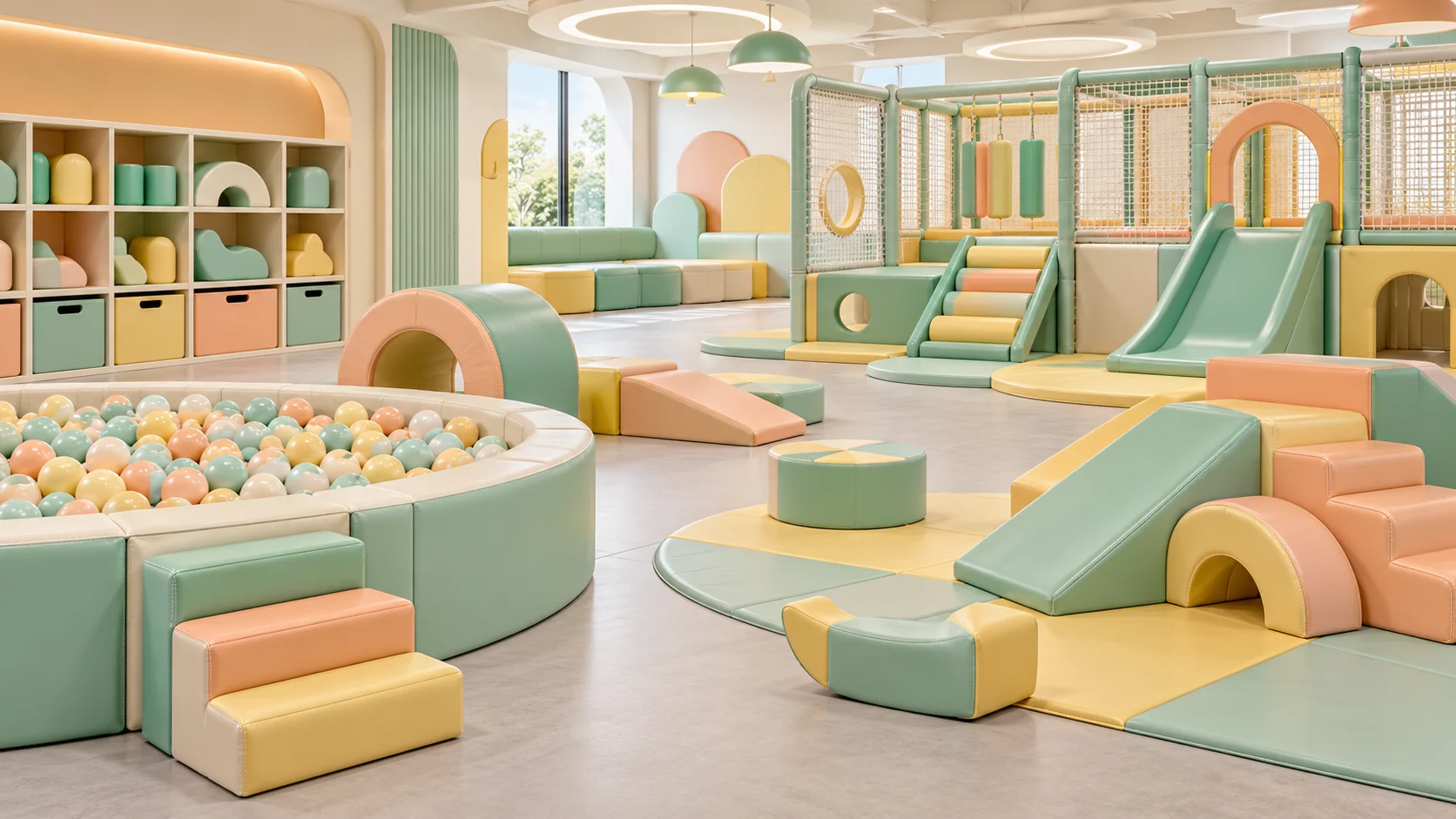
Soft Play Equipment Maintenance: What Should Buyers Confirm About Cleaning and Replacement Parts?
Quick Answer Before ordering soft play equipment, confirm the cleaning instructions for the supplied materials, access to areas that need

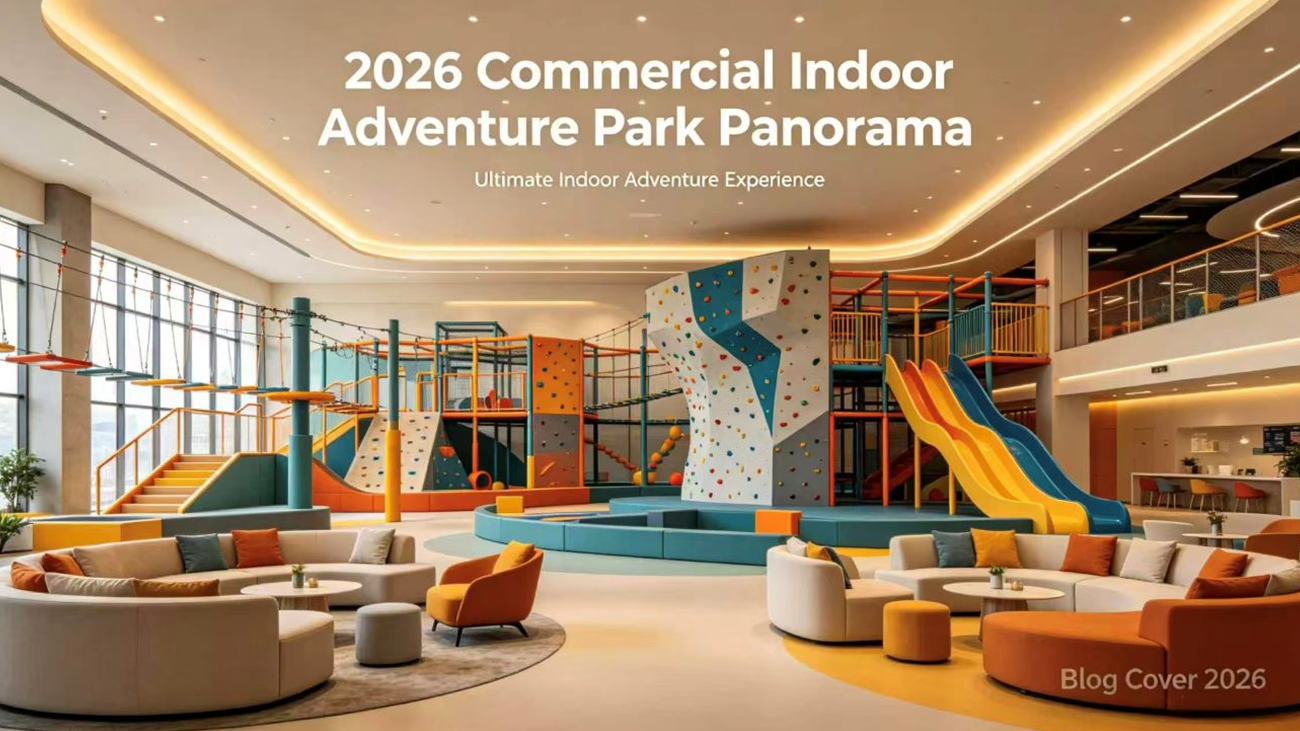
Table of Contents
ToggleAn adventure playground is a commercial or public venue featuring dynamic, challenge-driven, and immersive play structures. Unlike traditional facilities, an adventure playground prioritizes active participation and sensory-rich experiences to boost visitor satisfaction and profitability.
By shifting from equipment-centric to experience-centric design in 2026, these spaces create emotional resonance and high engagement. They are now essential assets for shopping malls and entertainment centers, as they meet rising demands for experiential learning and drive sustainable commercial success through longer dwell times and repeat visits.
An adventure playground is a professional play venue built on the core concepts of controlled risk, active exploration, multi-dimensional interaction, and age-adaptive challenge. Its core design philosophy is to allow users to gain physical exercise, mental growth, and social experience through voluntary exploration and challenge completion under scientific safety control. Different from ordinary playgrounds that focus on basic entertainment, adventure playgrounds take “adventure” and “exploration” as the core, setting graded challenge difficulty, diverse play modes, and immersive scene scenarios. The core value lies in balancing fun, safety, education, and commerciality, realising the dual goals of user experience improvement and sustainable commercial operation.
The differences between adventure playgrounds and traditional playgrounds are reflected in design logic, play experience, user value, and commercial attributes. Traditional playgrounds feature fixed, single-function equipment such as ordinary slides, swings, and seesaws, with simple operation, low interactivity, and homogeneous experience. They are mainly suitable for basic casual play, short dwell time, and low commercial revenue capacity. In contrast, adventure playgrounds adopt multi-functional integrated structures with diversified gameplay, including climbing, obstacle crossing, net exploration, and interactive sensing, supporting multi-person simultaneous play and progressive challenge. In terms of safety, adventure playgrounds implement scientific risk control rather than zero-risk protection, cultivating children’s risk judgment and self-protection ability. Commercially, adventure playgrounds support diversified revenue models with higher customer unit price and repurchase rate, making them suitable for high-value commercial operation.
Indoor and outdoor adventure playgrounds differ significantly in design focus, equipment selection, scene application, and operation mode. Outdoor adventure playgrounds are mostly located in parks, resorts, and scenic spots, making full use of natural terrain and ecological environments, with large-scale structures, great difficulty challenges, and open space layout. They feature low operating costs, rely on seasonal passenger flow, and are greatly affected by weather. Indoor adventure playgrounds are mainly distributed in shopping malls and FECs, with compact layouts, refined age zoning, and all-weather operability. They adopt weather-resistant, environmentally friendly, and high-safety materials, integrate digital interactive systems, and have stable passenger flow with strong commercial supporting attributes. In 2026, indoor adventure playgrounds with digital-physical hybrid gameplay have become the mainstream commercial choice, while outdoor ecological adventure parks are increasingly popular in tourism and resort projects.

Risk-safety balance is the primary core principle of adventure playground design, distinguishing it from traditional fully protected play spaces. Scientific design does not pursue absolute zero risk, but controls risk within a reasonable and predictable range, allowing users to experience moderate challenges while eliminating potential safety hazards. Designers need to comply with international safety standards such as ASTM and EN1176, optimize structural stability, fall protection systems, and equipment edges, and set reasonable height limits and load-bearing standards. Meanwhile, a graded difficulty design is adopted to match different age groups and ability levels, guiding users to explore within safe boundaries. This balanced design not only ensures operational safety but also retains the adventure and fun of the venue, realizing the integration of safety and experience.
Modern adventure playgrounds rely on multi-activity experience design to avoid single gameplay and extend user dwell time. The design integrates multiple play modes, including physical challenge, sensory interaction, creative exploration, and team cooperation, covering climbing, obstacle crossing, sliding, sensing games, and parent-child interaction. Each functional area has independent gameplay logic and mutual connections, allowing users to switch freely between different experiences. Multi-activity design meets the diverse needs of different age groups and play preferences, realizing a one-space multi-scene application, effectively improving venue space utilization, and significantly enhancing user stickiness and comprehensive experience.
Age-based zoning is a key strategy to improve venue professionalism and user experience, avoiding safety conflicts and experience mismatches caused by mixed-age play. Designers divide the venue into multiple functional zones according to the physical development characteristics and play needs of toddlers (2–4 years old), children (5–9 years old), and teenagers (10–14 years old). The toddler area focuses on low difficulty, high safety, and sensory cognition; the children’s area balances sports fun and interactive challenges; the teenager area sets high-difficulty obstacle courses and climbing projects. Independent zoning and reasonable spacing prevent crowd collision and resource competition, realizing precise matching of user groups and gameplay, and improving the overall operating efficiency of the venue.

Themed immersive design is the core means to enhance venue differentiation and commercial value in 2026. Different from conventional single equipment layout, themed design integrates scene stories, color systems, landscape decoration, and equipment modeling into a unified theme, such as jungle exploration, space adventure, ocean exploration, and castle fantasy. Through scene packaging, lighting rendering, and interactive atmosphere creation, the venue breaks the single-play attribute and builds a full-scene immersive experience space. Themed playgrounds have a stronger visual impact and story sense, are easier to form brand characteristics and word-of-mouth communication, support higher ticket pricing, and become online celebrity check-in points to drive spontaneous passenger flow growth.
Scientific flow and circulation planning ensure efficient operation and a smooth user experience of adventure playgrounds. Design needs to follow the principles of reasonable route planning, functional partition separation, and no dead-end flow, designing a one-way or circular play route to avoid crowd gathering and cross-flow congestion. The entrance, exit, rest area, service area, and play area are reasonably distributed to realize seamless connection between play, rest, and consumption. Meanwhile, considering peak passenger flow pressure, reserved buffer spaces and emergency passages are set up to ensure smooth personnel evacuation. Excellent circulation planning can effectively improve venue carrying capacity, reduce operational safety risks, and optimize the overall play rhythm of users.
Climbing structures are the core equipment of adventure playgrounds, covering low-level climbing walls, multi-layer climbing towers, bouldering areas, and vertical climbing nets. Made of high-strength galvanized steel and anti-slip HDPE materials, these structures feature stable load-bearing, weather resistance, and high safety. They are designed with graded difficulty, suitable for different age groups, helping users exercise limb coordination, core strength, and courage. Indoor climbing structures are compact and refined, matching themed scenes; outdoor climbing structures are large-scale and diversified, combining natural landscapes to create a multi-dimensional climbing experience. As the core challenge project, climbing structures are the key equipment to improve venue adventure attributes and user exercise value.
Rope courses and net systems are typical adventure play equipment, including high-altitude rope courses, low-altitude net mazes, suspension bridges, and net tunnels. All equipment adopts high-tensile safety ropes and anti-corrosion metal connectors, with redundant safety protection structures to ensure play safety. Rope and net equipment focus on balance training and space exploration, with strong interactivity and teamwork attributes, suitable for parent-child interaction and team challenge. In commercial venues, multi-layer three-dimensional net systems can maximize vertical space utilization, create layered adventure scenes, and effectively expand the play area without increasing floor space, which is very suitable for indoor FEC and mall venues with limited space.
Ninja-style obstacle courses are the most popular trendy equipment in 2026 adventure playgrounds, originating from sports challenge programs and optimized for commercial play scenarios. The course integrates multiple obstacle units such as balance beams, swing bars, crossing hurdles, tunnel obstacles, and stepping stones, with adjustable difficulty and freely combined modules. It supports single-person challenge and multi-person competition, with strong entertainment and competitiveness. Ninja obstacle courses have high playability and viewing properties, which can effectively stimulate users’ desire to challenge and compete, extend dwell time, and are suitable for setting up special challenge activities and regular competitions in venues to enrich operational content.

Modern adventure slide and tube systems have broken through the limitations of traditional straight slides, forming diversified combined play equipment including spiral tubes, wave slides, transparent tunnel slides, and multi-lane competitive slides. Made of food-grade anti-slip and anti-wear HDPE materials, the equipment is safe, environmentally friendly, and fade-resistant. The multi-dimensional combination of slides and tunnels creates a hidden exploration experience, matching adventure-themed scenes. As high-traffic and high-popularity basic equipment, slide systems undertake the main passenger flow of the venue, cooperating with climbing and obstacle projects to form a complete play loop and improve the continuity of user experience.
Interactive and sensory play elements are the key upgraded equipment of 2026 new-generation adventure playgrounds, realizing the integration of digital technology and physical play. Including LED interactive ground, touch-sensitive light walls, sound induction games, dynamic projection interaction, and sensory puzzle equipment, these elements bring a multi-sensory experience of vision, hearing, and touch. Suitable for toddler sensory training and children’s interactive entertainment, they make up for the single physical play of traditional equipment. Interactive equipment has strong novelty and interactivity, can effectively attract repeat visits, and improve the technological sense and differentiation of the venue, becoming an important profit-grabbing point for high-end commercial playgrounds.
In 2026, immersive themed design has become the mainstream trend of adventure playgrounds, abandoning the homogeneous and simple equipment stacking mode. Operators and designers focus on full-scene storytelling, creating exclusive themed scenes such as polar exploration, ancient forest, space journey, and pirate kingdom. Through customized equipment modeling, scene decoration, atmosphere lighting, and background sound effects, the venue realizes full-dimensional immersive coverage. Themed parks have strong brand recognition and scene uniqueness, which can form differentiated competition in the market, support premium ticket pricing, and trigger spontaneous social media dissemination, greatly improving the venue’s market competitiveness and passenger flow attraction.
The integrated development of adventure playgrounds and Family Entertainment Centers (FECs) has become an inevitable trend in the commercial market. Traditional single playgrounds are gradually eliminated due to a single function and limited revenue. Modern FEC-integrated adventure playgrounds integrate parent-child play, sports challenge, interactive games, catering, rest, and party services, forming a one-stop family entertainment space. This integrated mode enriches venue functional attributes, expands revenue channels, improves customer unit price and comprehensive profit margin, and meets the one-stop leisure needs of modern families. In 2026, most malls and commercial complex entertainment spaces will adopt this integrated design mode.
Digital-physical hybrid play is the core technological innovation trend of adventure playgrounds in 2026. Combining traditional physical adventure equipment with digital interactive technology, it breaks the limitations of fixed gameplay of traditional facilities. Through dynamic projection, AR interaction, intelligent induction, and data statistics systems, physical equipment can realize diversified and variable gameplay. For example, obstacle courses can switch between different challenge modes through digital control, and climbing walls can match interactive game scenes. This hybrid mode combines the sense of physical adventure and digital fun, greatly improving play freshness and tolerance, effectively solving the problem of single and easy-to-become-outdated traditional playground gameplay.
LED interactive adventure zones have become a popular high-end configuration in 2026 commercial playgrounds. Relying on high-definition LED screens, induction sensors, and interactive game systems, the area realizes dynamic scene switching and real-time human-computer interaction. It integrates competitive games, puzzle challenges, and parent-child interaction, with rich gameplay and strong technological sense. LED interactive zones can be adjusted according to festival activities and operation cycles, with high flexibility and strong scene renewal ability. As a high-value online celebrity check-in area, it can effectively improve venue popularity, increase user dwell time, and drive secondary consumption.
Modular and customizable equipment systems have become the mainstream choice for commercial playground construction in 2026, adapting to the diverse needs of different venues and budgets. Modular equipment adopts a standardized unit design, which can be freely combined and adjusted according to site size, spatial structure, and user positioning, with a short construction cycle and low transformation cost. On the basis of modularization, personalized customization such as theme modeling, color matching, and functional expansion can be carried out to meet the differentiated design needs of high-end venues. This mode balances standardization efficiency and personalized differentiation, reduces project investment risk, and facilitates subsequent venue upgrading and renovation, with high operational flexibility.
Equipment cost accounts for 50%–60% of the total investment of adventure playgrounds, and the unit price varies greatly according to equipment type and customization degree. In 2026 industry standards, standardized modular adventure equipment costs USD 30–80 per square meter; semi-custom themed equipment with simple scene optimization ranges from USD 80–150 per square meter; full-custom high-end immersive themed equipment with digital interaction functions reaches USD 150–300 per square meter. Indoor high-altitude rope courses and ninja obstacle projects have higher unit prices, about USD 280–400 per square meter. Material selection is the core factor affecting cost: HDPE high-density polyethylene materials are more expensive than ordinary plastic, but with ultra-low maintenance costs and longer service life.

Design and planning costs include site survey, overall layout planning, themed concept design, functional zoning design, and construction drawing design, accounting for 8%–12% of the total investment. For small and medium-sized standardized venues, the design cost is relatively low, about 6%–8% of the equipment cost; for large-scale customized themed adventure parks and FEC integrated venues, the design cost increases to 10%–12% of the total investment, involving professional scene packaging, brand visual design, and functional optimization. Professional design planning can effectively avoid layout defects and safety hidden dangers, improve space utilization and user experience, and lay a foundation for subsequent high-efficiency operation and ROI improvement.
Shipping and installation costs account for 10%–15% of the total project cost, affected by venue location, equipment volume, and project complexity. Standard modular equipment has convenient packaging and simple installation, with low transportation and construction costs; large-scale three-dimensional climbing structures, net systems, and customized themed equipment have large volume and complex assembly procedures, requiring professional construction teams and mechanical equipment, resulting in higher installation costs. Indoor venues need to coordinate ceiling height, load-bearing structure, and pipeline layout, increasing installation difficulty and cost. Outdoor venues need to adapt to terrain transformation and foundation construction, with slightly higher overall installation costs than indoor venues.
Site preparation and construction costs include ground leveling, foundation pouring, safety cushion paving, enclosure transformation, and supporting facility construction, accounting for 12%–18% of the total investment. Safety ground paving is the core expenditure: poured rubber, engineered wood fiber, and artificial turf are the mainstream materials, which need to meet international fall protection standards. Indoor venues need to carry out load-bearing detection and transformation, while outdoor venues need to complete drainage system construction and anti-corrosion treatment. For old venue renovation projects, the demolition and transformation cost will be increased by 3%–5%. High-quality site construction is the basic guarantee for venue safety and long-term operation.
Daily operation and maintenance costs are long-term recurring expenditures, mainly including equipment maintenance, safety inspection, venue cleaning, staff salary, and material replacement, accounting for 8%–10% of annual operating income. High-quality galvanized steel and HDPE materials can effectively reduce maintenance frequency and cost; digital interactive equipment requires regular system debugging and software upgrading, with slightly higher maintenance costs. Seasonal inspection, bolt fastening, anti-corrosion treatment, and safety surface cleaning are routine maintenance items. Reasonable maintenance management can extend equipment service life, reduce safety risks, and ensure stable venue operation.
Combined with 2026 industry data, the total investment of adventure playgrounds is divided into three grades according to scale and configuration. Small standardized indoor venues (100–300㎡): total investment ranges from USD 15,000–75,000, suitable for community and small mall supporting projects. Medium semi-custom themed venues (300–1000㎡): total investment ranges from USD 75,000–250,000, suitable for standard FEC and shopping mall core entertainment areas. Large full-custom immersive adventure parks (above 1000㎡): total investment exceeds USD 250,000, suitable for resort scenic spots, large commercial complexes, and brand flagship venues. The overall investment is positively correlated with customization degree, digital configuration, and venue scale.
Adventure playgrounds have diversified and multi-dimensional revenue streams, breaking the single ticket revenue model of traditional playgrounds. Ticket entry is the basic revenue source, including single tickets, combined tickets, and off-peak preferential tickets, covering the daily scattered passenger flow. Birthday parties are high-margin customized services, providing exclusive venue booking, scene layout, and interactive hosting, with high customer unit price and low marginal cost. Group events target kindergartens, training institutions, and enterprise team building, realizing large-scale passenger flow monetization. Membership programs include monthly cards, quarterly cards, annual cards, and stored-value memberships, locking long-term user groups, improving fund recovery efficiency, and stabilizing repeat visitor volume. The diversified revenue structure effectively disperses operational risks and improves comprehensive profitability.
The core profitability drivers of adventure playgrounds focus on four dimensions: foot traffic, dwell time, repeat visits, and seasonal promotions. Foot traffic is the foundation of revenue, relying on venue location, thematic differentiation, and social communication to expand passenger flow scale. Dwell time directly affects consumption possibility and user experience; multi-functional layout and interactive gameplay effectively extend stay time and increase secondary consumption opportunities. Repeat visits determine long-term profitability; membership systems, regular gameplay updates, and themed activities improve user viscosity. Seasonal promotions balance off-peak and peak passenger flow, launching holiday special activities, off-peak preferential policies, and weekend challenge events to stimulate consumption in low seasons and maximize annual revenue.
According to 2026 industry investment data, the payback period of standardized commercial adventure playgrounds is generally 18–24 months. Small community and public venues with low investment have a shorter payback period of 12–18 months; high-end customized themed parks and large FEC integrated venues have a payback period of 24–30 months due to high initial investment. In the first 6 months of opening, the venue is in the running-in period with low passenger flow and high promotion costs, and the revenue is relatively low. 6–18 months is the stable growth period, with continuous growth of repeat visitors and steady improvement of profit margin. After 18 months, the venue enters the mature profit period, with stable operating income and a continuous decline in marginal cost.
The long-term profitability of adventure playgrounds depends on four core factors: venue differentiation, operational refinement, user loyalty, and equipment renewal capabilities. Themed differentiation and digital interactive advantages can maintain market competitiveness and avoid homogeneous price competition. Refined operation, including activity planning, user management, and safety service, improves user satisfaction and word-of-mouth effect. Stable membership groups and repeat visitor volume form sustainable basic revenue. Regular equipment module adjustment and gameplay renewal prevent venue aging and user aesthetic fatigue. In addition, in-depth cooperation with merchants, schools, and institutions can expand offline resource channels and realize long-term stable profit growth.
The first step of design is to complete site analysis and user positioning confirmation. Site analysis includes measuring site area, spatial height, terrain conditions, indoor load-bearing, and surrounding supporting facilities, sorting out site advantages and limiting factors. At the same time, clarify venue attributes (commercial FEC, public community, scenic resort) and target user groups, confirm user age range, consumption capacity, and play preferences. Commercial venues focus on family consumer groups with high consumption willingness; public venues pay more attention to universal applicability and safety. Clear site conditions and user positioning lay the foundation for subsequent scheme design and budget formulation.
On the basis of site and user positioning, carry out project concept development and themed design. Combined with market trends and competitive product analysis, determine the core design concept and exclusive theme of the venue, and form a complete scene positioning and gameplay planning. For commercial venues, focus on immersive scene sense and differentiated competitiveness; for public venues, focus on practicality, safety, and universal playability. Complete theme color matching, scene atmosphere design, and core equipment styling planning, from preliminary design renderings and concept descriptions, and confirm the overall design direction with the investor.
Complete overall layout planning and functional zoning according to the design concept and site conditions. Divide the venue into independent functional areas such as a toddler play area, a children’s challenge area, a ninja obstacle area, an interactive experience area, a rest service area, and an emergency passage area. Follow the age zoning principle and flow circulation logic to optimize the spatial layout, ensure reasonable spacing between functional areas, smooth play routes, and avoid congestion dead ends. At the same time, reasonably allocate space proportion according to user group demand, increase the area of high-popularity and high-margin projects, and improve space utilization and operational efficiency.
Select matching equipment according to functional zoning and design theme, and complete supplier docking and scheme confirmation. Select equipment types and configurations according to budget and positioning: high-end commercial venues prioritize customized themed equipment and digital interactive systems; public venues prioritize standardized high-safety and high-cost-performance equipment. Verify equipment safety standards, material quality, and service life to ensure compliance with ASTM and EN1176 international specifications. Cooperate with professional manufacturers to optimize equipment combination, adjust equipment size and layout adaptively, and confirm production cycle, installation plan, and after-sales service terms.
Carry out full-cycle budget planning and ROI benefit simulation, covering initial investment and long-term operating costs. Refine the budget of equipment, design, transportation, installation, construction, and reserve emergency funds. Combine venue positioning, regional consumption level, and industry average data to simulate daily passenger flow, ticket revenue, derivative revenue, and annual operating cost, predict payback period, and profit margin. Adjust equipment configuration and layout scheme according to ROI simulation results, optimize investment structure, reduce invalid investment, and ensure the project’s economic feasibility and sustainable profitability.
Complete on-site installation, commissioning, and pre-operation preparation. Supervise the construction team to carry out equipment installation, safety ground paving, and supporting facility construction in strict accordance with construction drawings and safety specifications. After installation, complete equipment debugging, safety performance testing, and environmental cleaning. Formulate a daily operation management system, a safety inspection system, a staff training plan, and an opening activity plan. Complete safety compliance certification and acceptance, prepare the opening promotion and user drainage work, and realize smooth opening and stable operation of the project.
International safety standards are the core basis for adventure playground design and construction.EN1176 (EU Standard) and ASTM F1487 (US Standard) are the two most authoritative global playground safety specifications, covering equipment design, material performance, structural stability, safety spacing, and fall protection. All adventure playground equipment must meet the anti-corrosion, anti-slip, anti-collision, and load-bearing requirements of the two standards. The venue construction and safety paving also need to pass standard acceptance to ensure compliance with commercial operation and public use specifications. In 2026, cross-border commercial playgrounds will have fully realized unified compliance with dual standards to meet global operation requirements.
Impact absorption and fall protection are the key links of venue safety management. According to international standards, different play areas are equipped with matching safety buffer pavements: high-altitude equipment areas adopt thickened poured rubber and elastic cushion layers, and low-altitude play areas adopt artificial turf and engineered wood fiber. All equipment falling areas are fully covered by protective materials without hard ground exposure. At the same time, high-altitude adventure projects such as rope courses are equipped with professional safety harnesses, buffer ropes, and redundant protection structures to form multi-layer fall protection systems, effectively reducing fall injury risks.
Height limitation and structural safety design strictly follow international safety specifications. Designers set scientific height standards according to user age groups: toddler area equipment height does not exceed 1.5 meters, children’s challenge area height is controlled within 3 meters, and teenage high-difficulty adventure areas are equipped with full protection and special supervision. All steel structures adopt galvanized anti-corrosion treatment, with stable load-bearing capacity and wind resistance. Equipment connection parts are fixed with anti-loosening bolts, and sharp edges and corners are fully rounded and anti-collision treated to eliminate structural safety hazards.
Perfect supervision and operational safety systems are essential for long-term safe operation. The venue is equipped with standardized supervision posts, arranging professional safety instructors in key areas such as high-altitude climbing and obstacle courses to guide users to play safely and standardize operation behaviors. Establish a real-time monitoring system to cover all blind spots of the venue, and realize full-time safety monitoring. Formulate emergency response plans for accidents such as falls, collisions, and equipment failures, and conduct regular emergency drills to improve the team’s emergency disposal capacity.
Establish standardized daily, weekly, and monthly inspection and maintenance procedures. Daily inspection covers equipment surface, safety protection facilities, and ground cushion integrity to eliminate hidden dangers in time. Weekly maintenance includes bolt fastening, equipment cleaning, and flexible parts inspection and replacement. Monthly comprehensive inspection completes structural stability testing, anti-corrosion treatment, and digital equipment system debugging. Record all maintenance data to form complete equipment files, ensure long-term stable and safe operation of the venue, and extend equipment service life.
An overcrowded layout is the most common design mistake for novice developers. Excessive pursuit of equipment quantity and functional richness leads to dense equipment arrangement, insufficient play space and buffer distance, easy to cause user collision and crowd congestion. An overcrowded layout will also block the flow line, affect play experience, and greatly increase safety supervision pressure. In serious cases, it will fail safety acceptance and affect normal operation. Excellent design needs to balance equipment richness and spatial comfort, reserve sufficient play buffer space and pedestrian passage, and avoid blind stacking of equipment.
Insufficient safety design and an imperfect risk control strategy are key factors leading to operational hidden dangers. Some projects ignore standardized safety configuration in order to save costs, such as unqualified safety ground paving, missing protective facilities, and non-compliant equipment spacing. Some designers blindly pursue adventure difficulty without setting graded protection and supervision mechanisms, resulting in unbalanced risk and safety. A weak safety strategy will not only bring potential safety hazards, but also lead to operational disputes and qualification risks, seriously affecting the venue's reputation and sustainable operation.
Blindly copying popular schemes and ignoring target user positioning is a common design misunderstanding. Many projects indiscriminately configure high-difficulty adventure equipment and high-tech interactive projects without combining regional user age structure and consumption characteristics, resulting in mismatched product and demand. For example, community venues with mainly toddler groups are equipped with a large number of high-difficulty ninja obstacle courses, resulting in low equipment utilization; high-end mall venues with high consumption groups adopt low-end standardized equipment, resulting in insufficient attraction and difficulty in premium pricing.
Most developers only focus on initial equipment and construction investment and seriously underestimate long-term operational and maintenance costs. Daily cleaning, staff salary, equipment maintenance, material replacement, and system upgrading are continuous fixed expenditures. Insufficient budget reserve in the early stage will lead to inadequate later operation, aging venue environment, and faulty equipment operation, seriously affecting user experience and word-of-mouth. Reasonable full-cycle cost budgeting must be carried out in the design stage to reserve sufficient operational funds.
Unreasonable revenue structure and unclear profit model lead to poor ROI performance. Some projects rely too much on single ticket revenue, lacking derivative service revenue and membership locked revenue, resulting in a single profit source and poor anti-risk ability. Some projects have unreasonable equipment collocation, excessive investment in low-utilization equipment, and insufficient layout of high-margin projects, resulting in low overall profit margin. Early design must combine ROI simulation to optimize project layout and revenue system, and build a diversified and high-efficiency profit model.
FEC is the core application scenario of modern adventure playgrounds, and adventure play equipment is the core supporting asset of high-quality FECs. Integrated adventure playgrounds enrich FEC functional attributes, form a one-stop family entertainment matrix covering sports, challenge, interaction, and leisure, effectively improving venue passenger flow and comprehensive profit margin. FEC-oriented adventure playground design focuses on high interactivity, high playability, and diversified revenue adaptation, matching membership systems and customised service projects to meet the all-weather entertainment needs of family groups.
Shopping malls are the largest carriers of indoor adventure playgrounds in 2026. As the core passenger flow engine of malls, adventure playgrounds can drive retail, catering, and secondary consumption, and improve the mall's customer retention rate and floor efficiency. Mall playground design focuses on space saving, high appearance, and strong differentiation, adopting modular and themed customized schemes to adapt to different floor heights and spatial structures. Through online celebrity scene creation and regular activity operation, it forms a stable passenger flow attraction and becomes an important part of the mall's commercial operation.
Independent indoor commercial adventure playgrounds are mainly located in commercial buildings and community supporting spaces, facing specific family consumer groups. Such venues focus on refined zoning, high safety, and high cost performance, with flexible scale and low investment threshold. Suitable for small and medium-sized investment projects, they rely on the surrounding community's passenger flow to realize stable operation. The design focuses on practical gameplay optimization and user viscosity improvement, relying on membership systems and regular small-scale activities to maintain long-term stable profitability.
Resort and scenic spot adventure playgrounds are mainly outdoor large-scale themed parks, combining natural ecological landscapes to create immersive outdoor adventure experiences. Such projects have a large scale, a high degree of customization, and strong tourist attraction, suitable for holiday passenger flow operation. The design focuses on integration with natural scenery, ecological protection, and tourist experience, supporting team expansion, parent-child travel, and tourist check-in, becoming the core supporting project of scenic spot leisure entertainment and improving tourist stay time and comprehensive consumption.
School and community adventure playgrounds belong to public welfare and semi-commercial projects, focusing on safety, practicality, and universal applicability. The design abandons excessive luxury customization, adopts high-cost-performance standardized equipment, carries out scientific age zoning and safety optimization, and meets the daily play and physical exercise needs of children in the community and school students. Such projects have low investment, low operating cost, stable passenger flow, and certain social benefits, and can realize balanced operation through low-price charging and public welfare operation modes.
In the post-2026 era, AI-driven intelligent interactive systems will become the core upgrade direction of adventure playgrounds. AI technology can realize intelligent identification of user age, height, and ability, automatically adjust equipment difficulty and gameplay mode, and realize personalized adaptive play. At the same time, AI big data analysis can monitor user play behavior, count popular gameplay and user preferences, provide data support for venue activity planning and equipment upgrading, and realize refined intelligent operation of the venue.
Smart connected playgrounds will realize full-scene digital management and intelligent interaction. Through Internet of Things (IoT) sensors, all equipment operation status, safety data, and passenger flow information can be monitored in real time. The venue can realize intelligent temperature adjustment, light switching, and scene switching, improving operational efficiency and user experience. Users can complete ticket checking, route navigation, and interactive game participation through mobile terminals, realizing the integration of online and offline play experience and building a fully connected smart play space.
The digital-physical hybrid mode will be fully popularized and upgraded, breaking the boundary between traditional physical play and digital entertainment. Future adventure zones will integrate AR/VR virtual adventure, dynamic projection interaction, and physical challenge equipment to realize multi-scene and multi-dimensional composite gameplay. The same physical space can switch multiple adventure themes and challenge modes through digital technology, solving the problem of single fixed gameplay, greatly improving venue freshness and repeat play rate, and becoming the mainstream form of high-end commercial playgrounds.
Environmental protection and sustainability will become the universal design standard of future playgrounds. More recyclable, degradable, and low-carbon eco-friendly materials will replace traditional materials, reducing project carbon emissions. High weather resistance, anti-fading, and low-maintenance environmental protection materials can reduce later operation and replacement costs, realizing long-term energy conservation and emission reduction of the venue. Ecological and natural design will also become popular, integrating natural elements and ecological landscapes to create green and healthy play spaces.
Ultra-immersive full-scene experience design will further upgrade the venue’s competitive advantage. Future playgrounds will realize full-dimensional scene coverage from vision, hearing, touch, and even smell, combining story-based scene iteration, dynamic atmosphere rendering, and interactive plot progression. The venue is no longer a simple play space but a complete immersive adventure scene, bringing users a strong sense of substitution and unique memory points, forming irreplaceable market differentiation and sustainable brand value.
An adventure playground is a professional immersive play venue centered on active exploration and controlled risk challenge. Different from traditional single-function playgrounds, it integrates diversified equipment such as climbing structures, obstacle courses, and digital interactive systems, adopts scientific age zoning and safety balance design, and focuses on cultivating children’s physical ability, exploration spirit, and problem-solving ability. It is widely used in commercial FECs, shopping malls, resorts, and public community spaces, and is the mainstream high-value play form in the 2026 experience economy era.
The total investment of adventure playgrounds varies by scale, customization degree, and functional configuration. Small standardized venues (100–300㎡) cost USD 15,000–75,000; medium semi-custom themed venues (300–1000㎡) cost USD 75,000–250,000; large full-custom immersive parks (over 1000㎡) cost more than USD 250,000. The unit equipment cost ranges from USD 30–300 per square meter, with customized digital and high-altitude adventure projects having higher unit prices. The total cost includes equipment, design, construction, installation, and long-term operational maintenance.
Adventure playgrounds have excellent profitability and are high-growth investment projects in 2026. They have diversified revenue streams, including ticket sales, birthday parties, group events, and membership programs, with high customer unit price and user viscosity. The industry average payback period is 18–24 months, and mature venues can achieve stable profit growth for a long time. Compared with traditional playgrounds, they have stronger anti-risk ability and a higher comprehensive profit margin, suitable for commercial investment and public supporting projects.
Core adventure playground equipment includes five categories: climbing structures (climbing walls, multi-layer climbing towers), rope courses and net systems (high-altitude rope ways, net mazes), ninja-style obstacle courses (balance obstacles, competitive challenge units), slides and tube systems (spiral tubes, multi-lane competitive slides), and digital sensory interactive equipment (LED interactive zones, projection induction games). All equipment complies with ASTM and EN1176 international safety standards, supporting modular combination and personalized customization.
The construction cycle of adventure playgrounds depends on the project scale and customization degree. Small standardized venues take 1–2 months from design to completion; medium semi-custom themed venues take 2–4 months; large full-custom immersive adventure parks take 4–6 months, including scheme design, equipment production, on-site installation, safety debugging, and acceptance. The overall cycle is flexible, and the construction progress can be optimized according to the investor’s opening plan.
As a high-growth investment in 2026, adventure playgrounds drive superior ROI by replacing monotonous, equipment-centric models with immersive, experience-based venues that boost dwell time and repeat visits. Successful implementation relies on a strategic balance of safety, professional zoning, and data-driven operational refinement to ensure long-term competitiveness.
To maximize your project's potential and avoid costly homogeneous competition, prioritize personalized, compliant design tailored to your specific site and target demographic. Partner with our expert team today to leverage professional design, standardized safety management, and turnkey solutions to secure your market position and ensure sustainable, high-performing returns.
Quick Answer Before ordering soft play equipment, confirm the cleaning instructions for the supplied materials, access to areas that need
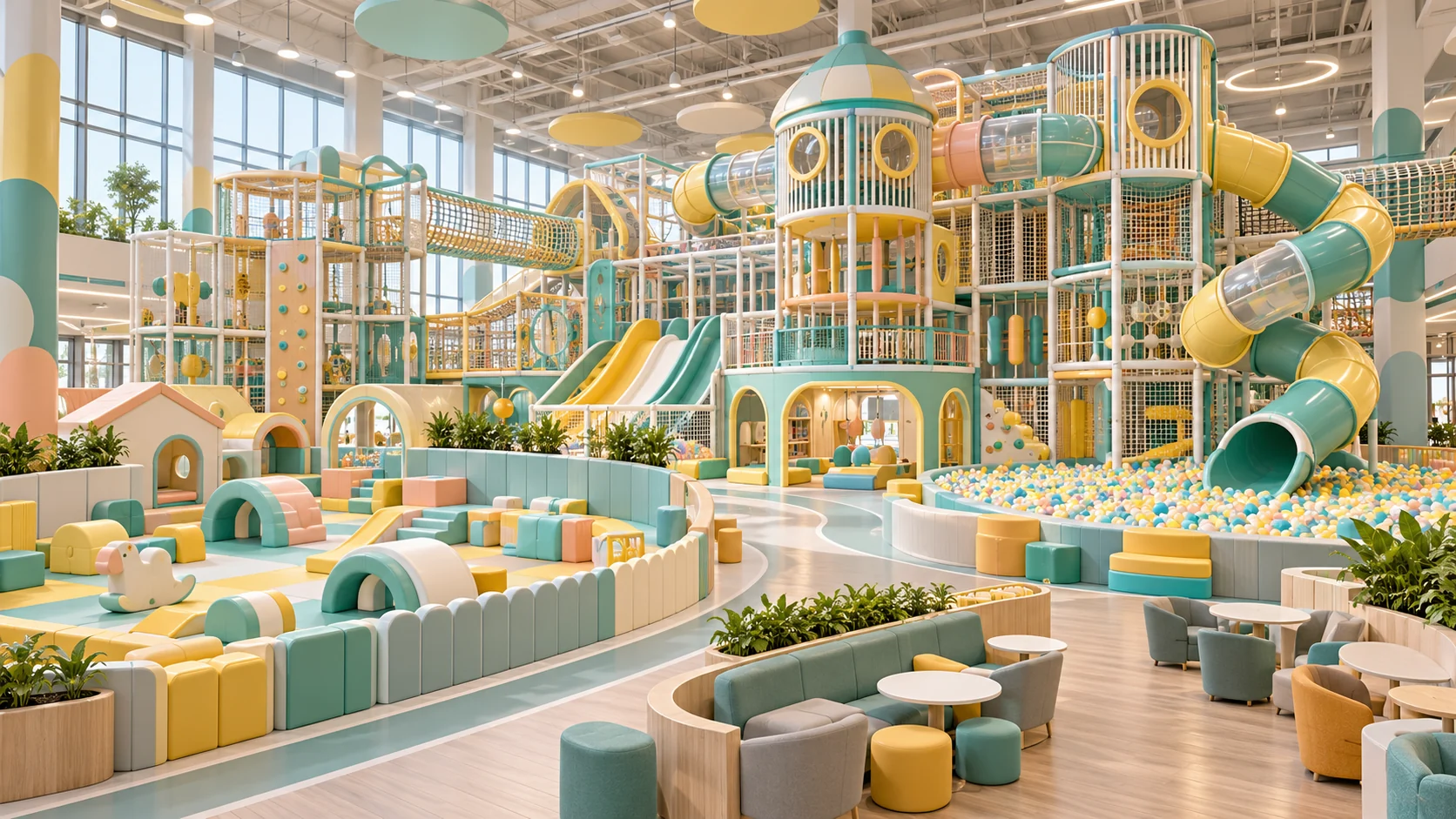
Quick Answer Compare commercial indoor playground equipment proposals in two connected parts: how the layout serves the venue, and what
Thank you very much for your inquiry! Your trust is our greatest motivation. We are committed to offering playgrounds that combine high quality with affordable pricing. Let us bring vitality to your venue!