
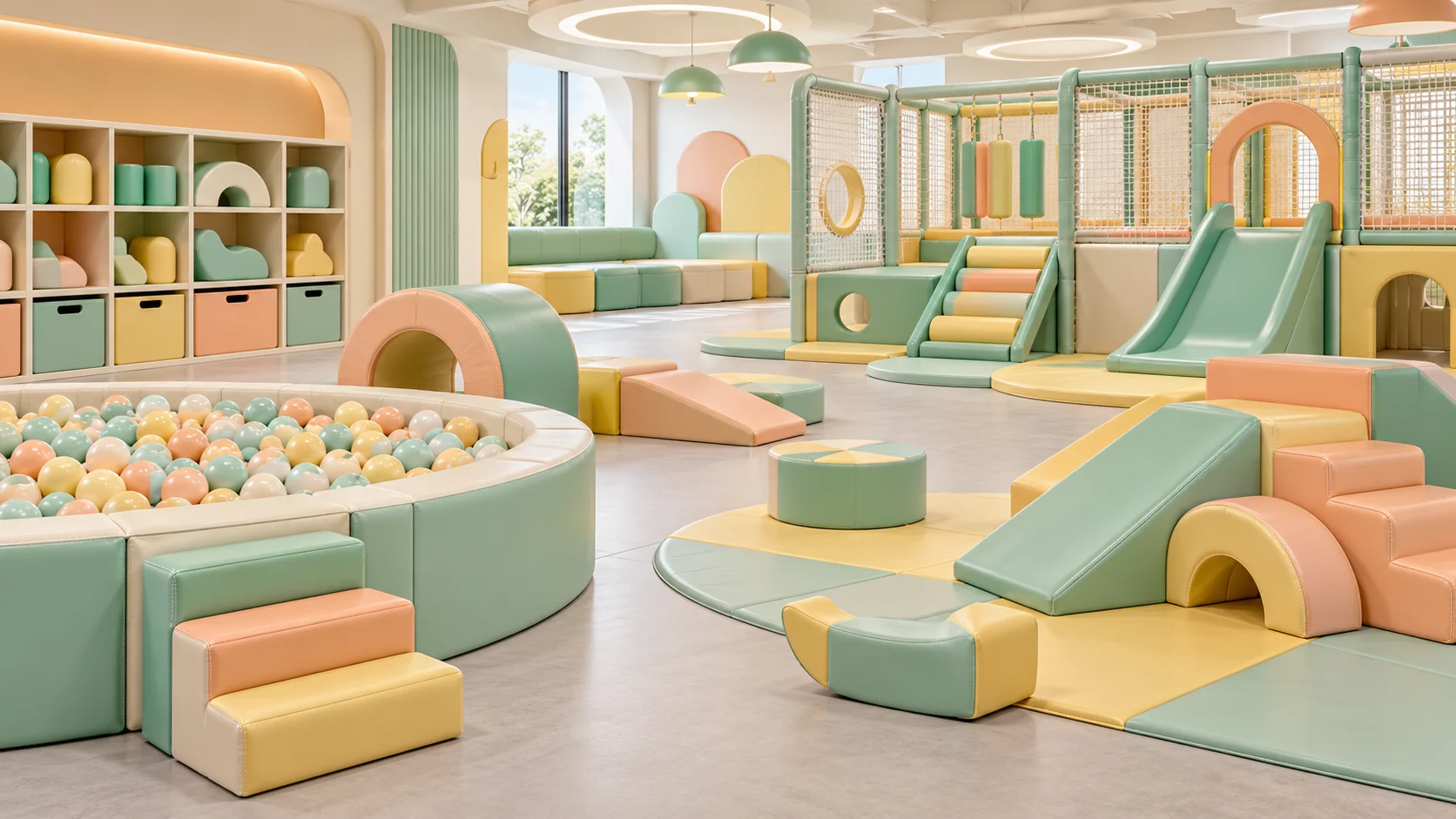
Soft Play Equipment Maintenance: What Should Buyers Confirm About Cleaning and Replacement Parts?
Quick Answer Before ordering soft play equipment, confirm the cleaning instructions for the supplied materials, access to areas that need

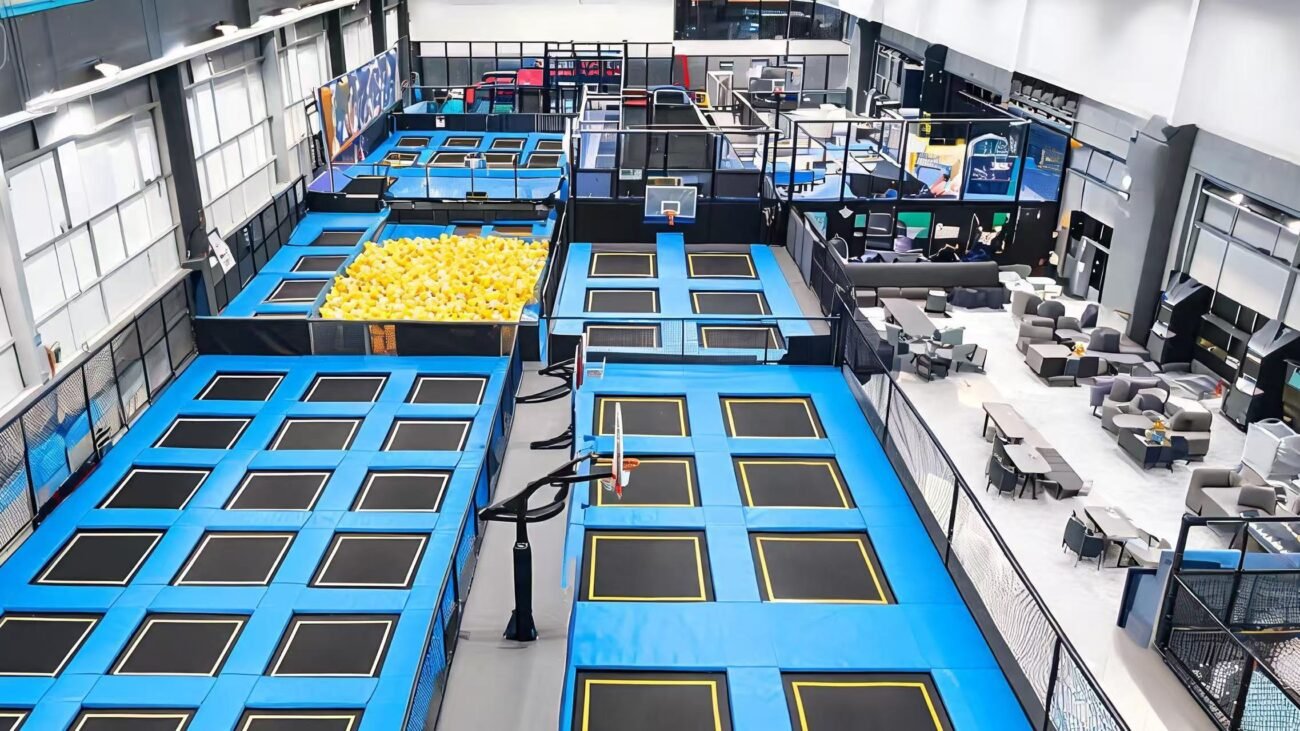
Table of Contents
ToggleThis Indoor Trampoline Park Size and Height Planning Guide walks you through key considerations that directly determine the indoor trampoline park design and personal safety.
All three play a key role in scientific trampoline park layout planning.
This paper introduces the key design points of standardized indoor trampoline park design, helping investors efficiently complete site planning and layout design.
Choosing a trampoline park size is the primary prerequisite for designing an indoor trampoline park. The following size bands are illustrative planning labels, not required minimum areas or capacity approvals. Confirm usable area, equipment footprints, circulation, supervision and service access against a measured site plan.
| Key Indicators | Small Trampoline Parks(300–800 sqm) | Medium Trampoline Parks(800–2000 sqm) | Large Trampoline Parks(2000–5000+ sqm) |
| Customer Capacity | It mainly targets individual customers. | The passenger flow remains stable. | It is capable of receiving large crowds. |
| Zone Distribution | Usually, only the core jumping area is equipped. | Jumping areas coexist with various interactive facilities. | It features complete functional zones and supporting facilities. |
| Commercial Investment Scale | It is suitable for community stores. | It is a mainstream option for commercial trampoline parks. | It demands higher investment and positions itself as a comprehensive entertainment venue. |
Besides a proper trampoline park size, the ceiling height of the trampoline park must also meet relevant standards.
There is no single height figure in this guide that establishes suitability for every attraction. Record clear height below beams, ducts, lights and other obstructions, then confirm the selected equipment drawings and site review before approving a layout.
Different amusement items have different requirements for ceiling height.
| Activity Type | Clear Height to Confirm | Suitable Venue Type | Key Safety Note |
| Basic Open Jump Zone | Confirm selected jump equipment and overhead clearance | Subject to equipment and site review | Basic jumping movements can be performed here. |
| Basketball Dunk Zone | Confirm dunk activity and equipment clearances | Medium & large venues | Reserve space for takeoff and stretching. |
| Foam Pit & High Dive Area | Confirm the specific landing system and activity design | Medium & large venues | Provide sufficient buffer space for landing movements. |
| Ninja Obstacle Course | Confirm obstacle, support and user movement clearances | Medium & large venues | Meet the space requirements for climbing and crossing. |
Adequate safety clearance is an indispensable part of the design of commercial trampoline parks, as it can prevent accidents like high-altitude collisions, falls and injuries. Safety clearance standards differ across various core areas.
Reasonable space planning is the key to trampoline park layout planning and professional indoor trampoline park design to ensure the stable operation of the venue.
Introduce the essential functions and their respective roles.
The two areas need reasonable allocation, balancing visitors' experience and space utilization.
Plan pedestrian flow scientifically to prevent crowd gathering.
| Zone | Allocation Basis | Feature |
| Jump Area | Selected equipment footprints and use clearances | Core play area |
| Activity Zone | Chosen activity mix and circulation | Diversified games |
| Supporting Area | Reception, seating, storage and service needs | Service facilities |
| Safety Zone | Site-specific clearance and access review | Emergency passages |
Equipment must be kept at standard intervals to ensure visitors' safety.
Walls and columns are hard building structures and shall comply with protection regulations during indoor trampoline park design.
Buffer zones can be created by installing reliable anti-collision facilities and optimizing the building load-bearing structure.
This method can not only optimize trampoline park layout planning, but also improve the overall visiting experience of the indoor trampoline park design.
The children's area requires a low-risk layout with greater focus on safety.
Zoning design for the two groups can avoid conflicts and safety incidents.
The adult play area should take interactive safety, parent-child space and full monitoring coverage into account to meet the needs of family visits.
Supporting facilities can improve visitors' overall play experience.
Proper planning of the front desk and entrance helps simplify trampoline park layout planning and improve passenger flow management efficiency.
The areas of the two zones shall match the overall trampoline park size and meet visitors' basic usage needs.
Nowadays, party services have become a major profit source for trampoline parks. Suppliers can boost profits by offering party areas.
Cafés and rest areas are an indispensable part of indoor trampoline park design.
| Item | Core Actions | Target Users |
| Customer Flow Optimization | Set up clear passages and guide signs | All guests |
| Revenue-Oriented Spaces | Food & Beverage Sales | Players & families |
| Waiting Area Layout | Arrange seats, charging ports and a kids' play corner | Accompanying guests & waiters |
Scientific passenger capacity planning and reasonable profit schemes help trampoline park operators maximize profits.
It is necessary to set a reasonable maximum number of visitors per unit area.
Plan daily trampoline park layout and venue flow during peak hours to reduce potential safety hazards.
Diversify amusement projects to boost long-term revenue. Optimize birthday party packages, improve ticketing systems, and launch distinctive value-added services to expand profit channels.
Confirm equipment requirements and the responsibilities for reviewing the actual venue before ordering.
Ask which current documents apply to the ordered equipment and destination market, including their product scope, report holder and date. Do not treat one standard name or equipment report as approval for the whole venue; building, structural, fire and operating reviews need separate confirmation.
Shock-absorbing materials must be used in indoor trampoline park design to reduce injuries.
| Safety Module | Core Requirements | Implementation Priority |
| Enclosure Installation Standards | Keep intact, safe and firm | Highest |
| One Jumper Per Trampoline Rule | No multiple people jumping on one trampoline | Highest |
| Foam Pit Safety Standards | Confirm the specified landing system, documentation and maintenance requirements | High |
| Daily Emergency Safety Checklist | Conduct a full inspection before daily opening | High |
Most operational problems stem from inadequate early planning.
Many investors overlook the height limit, resulting in failure to meet the relevant trampoline park height requirements.
Unreasonable space planning leads to low space utilization and resource waste.
Poor zoning layout creates potential safety hazards.
Blind planning will lead to various problems, so practical profit planning is needed to address these issues.
Hire a professional team to customize the plan based on the site conditions.
Use 3D design tools to visualize the trampoline park layout planning.
Leave room for expansion to balance safety and long-term profits.
Minimum clear height depends on the selected activity and equipment design. Supply measured heights below obstructions for each zone and obtain project-specific confirmation; a nominal building height is not enough.
The trampoline park size shall be determined according to different operation scales. This article is for reference.
Visitor capacity is determined by trampoline park size and functional zoning.
It mainly includes jumping areas, interactive areas, rest areas and other zones, which require reasonable trampoline park layout planning.
A nominal 6m ceiling does not establish suitability. Check usable clear height, obstructions, selected activities, equipment drawings and required clearances with the responsible project parties.
For safety purposes, follow a compliant indoor trampoline park design for equipment spacing and conduct scientific planning for indoor trampoline parks.
Early planning determines the operational performance of the venue. Investors shall first confirm the appropriate trampoline park size and minimum floor height requirements and optimize the overall trampoline park layout planning to ensure stable operation.
All three aspects must be taken into account. Neglecting anyone will lead to potential safety hazards or low space utilization.
It is recommended that investors select venues with qualified ceiling heights, optimize functional zones and trampoline park height requirements, and build safe and profitable commercial trampoline parks.

Quick Answer Before ordering soft play equipment, confirm the cleaning instructions for the supplied materials, access to areas that need
Quick Answer Compare commercial indoor playground equipment proposals in two connected parts: how the layout serves the venue, and what
Thank you very much for your inquiry! Your trust is our greatest motivation. We are committed to offering playgrounds that combine high quality with affordable pricing. Let us bring vitality to your venue!